
From storage screening to detailed simulation
How much CO₂ can a formation accommodate, where should it be injected, and what happens after injection ends? The answers depend on geology, flow properties, operating decisions and the physical processes represented in the model. We develop computational methods to investigate these relationships across spatial scales and over long time horizons.
We work with industrial partners and research organisations to:
- Analyse CO₂ migration, structural traps and the mechanisms that retain CO₂ in the subsurface.
- Assess storage capacity, pressure buildup and alternative injection strategies.
- Develop detailed flow models and efficient models for screening and scenario analysis.
- Couple flow and geomechanics to investigate injection-induced stress and deformation.
- Perform sensitivity and uncertainty analyses and develop tailored computational tools.
Get in touch with our Applied Computational Science research group to discuss a storage modelling challenge or the development of new simulation methods.
Choosing the right model for the question
CO₂ storage involves interacting processes that operate on different spatial and temporal scales. The relative importance of pressure-driven flow, buoyancy, capillary forces and dissolution changes during injection and subsequent migration. Our introduction to the basics of geological CO₂ storage modelling explains these processes and the main trapping mechanisms.
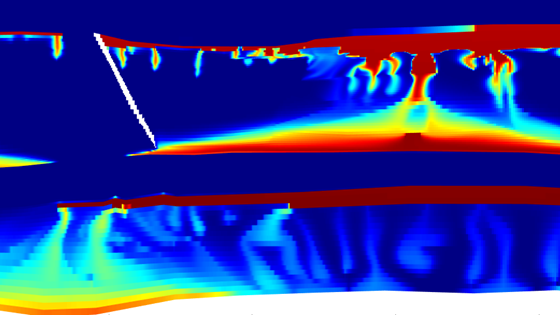
We develop compositional models and multiphase flow models with simplified descriptions of fluid properties and phase behaviour, as well as reduced models based on spill-point analysis and vertical averaging. This range allows us to adapt the physical detail and computational cost to the questions being investigated.
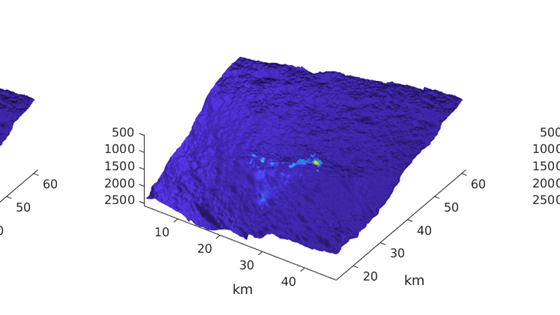
Detailed three-dimensional models are useful when local conditions and interactions between physical processes need to be resolved. For regional assessments and long-term migration studies, vertical-equilibrium models can substantially reduce computational cost by combining vertical integration with assumptions about the vertical fluid distribution. We also combine detailed and reduced models within the same simulation, concentrating computational effort where it is needed.
Structural trapping and long-term migration
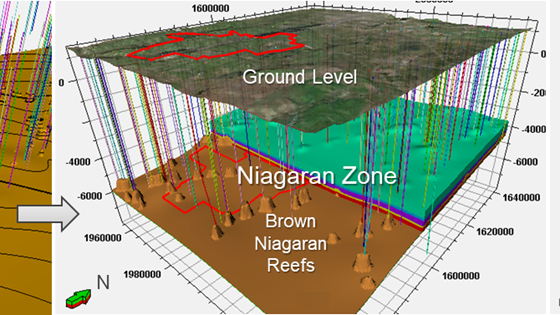
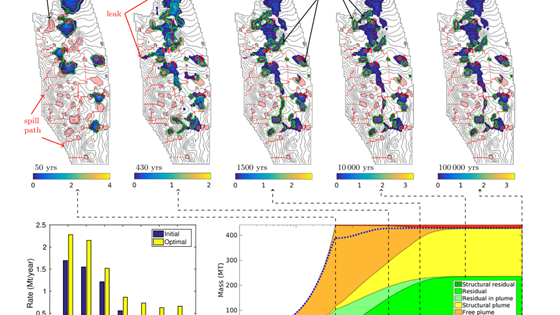
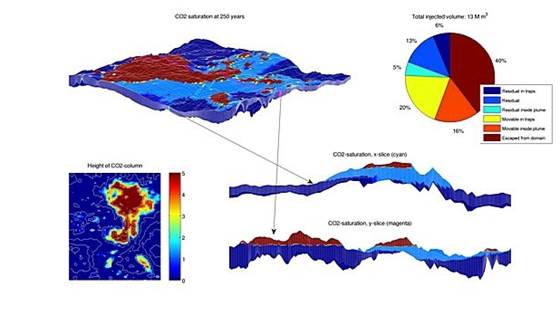
The shape of the formation beneath the caprock strongly influences where buoyant CO₂ migrates and accumulates. Our tools for structural trapping and spill-point analysis identify traps, estimate their volumes and map the spill paths connecting them. These inexpensive calculations provide a useful starting point for screening storage areas and selecting scenarios for more detailed simulation.
Migration may continue long after injection stops. We develop methods for forecasting long-term migration that use spill-point dynamics to estimate the eventual distribution of CO₂ without explicitly simulating the entire migration period. These forecasts can support the assessment of injection strategies by accounting for migration beyond the time horizon of a conventional simulation.
Open-source tools for storage assessment
MRST-co2lab brings together tools for analysing CO₂ storage over large spatial and temporal scales. It supports workflows from structural trapping analysis and interactive exploration of geological data to simulation of pressure buildup, plume migration and trapping. For detailed flow simulation, we also use and develop OPM Flow and JutulDarcy.
Access to the source code makes it possible to examine model assumptions, introduce additional physical processes and adapt simulations to project needs. The software also provides a foundation for comparing methods and reproducing computational results.
Shared benchmarks and open data
SINTEF co-organised SPE11, the 11th SPE Comparative Solution Project, an international benchmark for geological CO₂ storage simulation. Shared benchmark problems provide a basis for comparing simulation tools, investigating differences between results and assessing the influence of numerical methods and modelling choices.
We also support access to data through CO₂ DataShare, a portal managed by SINTEF that makes curated datasets from research, demonstration and industrial-scale CCS projects available to the wider community. Such datasets provide valuable resources for developing and evaluating models and for building reproducible research workflows.
Pressure, geomechanics and uncertainty
Injection changes both pore pressure and the mechanical state of the subsurface. Coupled models can be used to investigate how pressure changes affect stress and deformation, and how these changes in turn influence flow.
Model results must be interpreted in light of uncertainty in geology, material properties and boundary conditions. We focus on identifying the assumptions that govern the results and the level of detail needed to answer the question at hand. This includes assessing when reduced models are appropriate and when additional physical detail or finer resolution is required.