


Jutul
Experimental Julia framework for fully differentiable multiphysics simulators based on implicit finite-volume methods with automatic differentiation.

Simulating flow in porous media requires an understanding of fluids, geological structures and physical processes, combined with efficient numerical methods. We develop the full computational chain: from mathematical models and discretisation to solution algorithms, simulators and tools for analysis and optimisation.
Through sustained research and industrial collaboration, we have developed methods and open-source software used both to explore new ideas and to solve demanding reservoir problems. This connection between mathematics, software and practical applications is central to our work.
We help partners develop new models, improve accuracy and computational efficiency, extend existing simulators and establish workflows for simulation, sensitivity analysis and optimisation. Contact our Applied Computational Science research group to discuss the possibilities.
Our expertise covers single-phase and multiphase flow, compositional modelling, and the transport of heat and chemical components. We work with heterogeneous and fractured formations, complex computational grids, and coupling between flow and other physical processes.
A recurring objective is to make it possible to simulate more detailed models and investigate more alternatives within the available time and computing resources. Our work includes:
The MRST website includes descriptions and examples of our multiscale methods and flow diagnostics tools.
Making research available through open-source software has long been a strategic priority. It enables others to examine methods, reproduce results and build on our work. The software also provides a shared platform for collaboration between research and industry.
The MATLAB Reservoir Simulation Toolbox (MRST), developed at SINTEF, is used internationally for research, teaching and the development of new simulation methods. It combines a broad range of physical models with numerical methods and examples that users can adapt and extend.
MRST provides established reservoir simulation models alongside specialised methods for applications such as CO₂ storage, geothermal energy and flow in fractured formations. Automatic differentiation and adjoint methods support sensitivity calculations, optimisation and model calibration.
Hundreds of scientific papers from other research organisations document how MRST is used and extended. Examples, documentation and software are available on the MRST website.
We co-develop OPM Flow, an open-source reservoir simulator used for industrial field studies, including by Equinor. Our work covers physical models, numerical solvers and computational performance, together with professional support and maintenance delivered with our partners.
OPM connects numerical research with the demands of practical reservoir studies: large models, complex production histories, established data formats, and reliable and efficient simulation.
JutulDarcy.jl is our Julia-based simulation engine for multiphase flow. It combines flexible models with automatic differentiation and efficient numerical methods. Differentiability allows simulations to be used directly in gradient-based optimisation, parameter estimation and workflows that combine physics-based models with machine learning.
The same platform underpins Fimbul.jl for geothermal reservoir simulation. Open and extensible simulators also provide a foundation for agent-assisted workflows in which users can construct, run and investigate models through dialogue with an AI agent.
Our two textbooks on MRST and reservoir simulation bring together mathematical models, numerical methods and practical implementation. Both are available through open access and accompanied by code and examples that readers can run and extend.
The books reflect the breadth of our work, from fundamental flow models and discretisation to advanced reservoir physics, efficient solution methods and coupled processes.
Experimental Julia framework for fully differentiable multiphysics simulators based on implicit finite-volume methods with automatic differentiation.

A free open-source community code for rapid prototyping of new methods for modelling and simulation of flow in porous media. Has a large user community from all over the world.

The Open Porous Media (OPM) initiative provides open-source software for simulation, upscaling and visualization of porous media processes, in particular subsurface reservoirs.
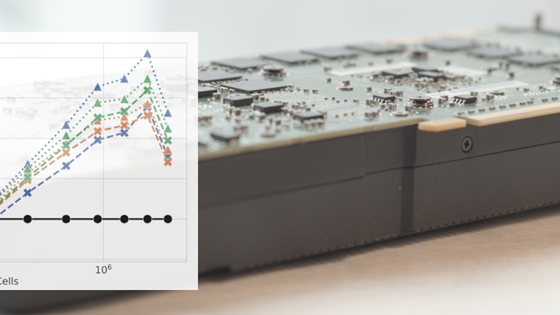
The goal of this project is to improve the performance of the OPM Flow reservoir simulator by exploiting GPU acceleration.
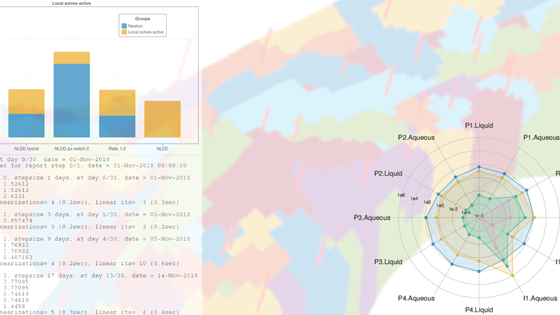
Reservoir simulation, an essential tool in the oil and gas industry for predicting reservoir behavior, often incurs significant computational expenses. This arises from the intricate nature of subsurface flow dynamics and the need for high-fidelity...
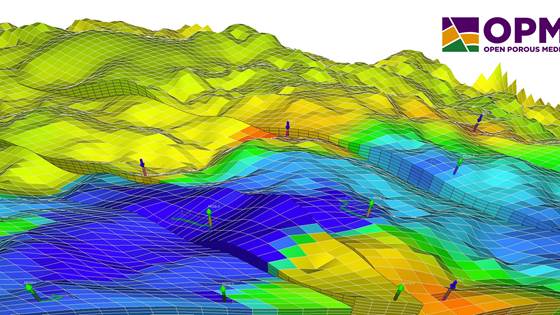
In this project, a consortium consisting of SINTEF, NORCE and OPM-OP provide support and maintenance services for the OPM Flow reservoir simulator software.
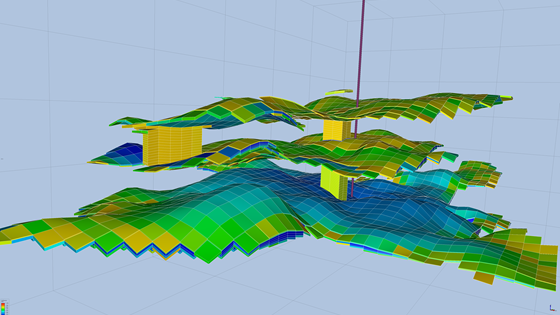
ACROSS aims to combine traditional High-Performance Computing (HPC) techniques and workflows with Artificial Intelligence (AI) and Big Data analytic techniques to enhance productivity and efficiency.
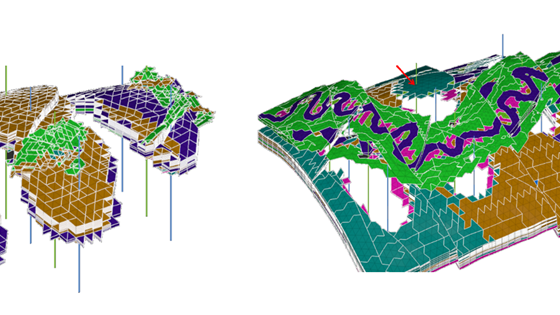
To optimize hydrocarbon reservoir recovery, understanding and predicting flow and transport processes is crucial. Geo-cellular models, representing complex rock formations, often contain millions of cells, requiring hours for simulation. To expedite...
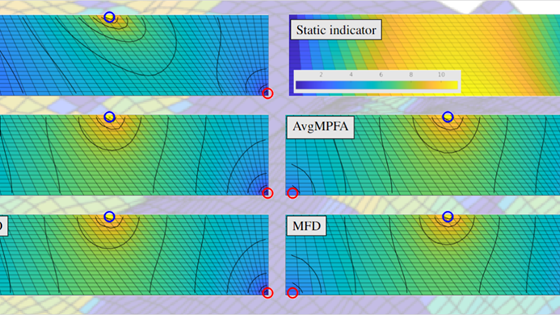
The purpose of the project is to assist the client in the development of an industrial solution for multiphase and coupled flow-geomechanical simulations on unstructured grids representing structurally complex reservoirs.
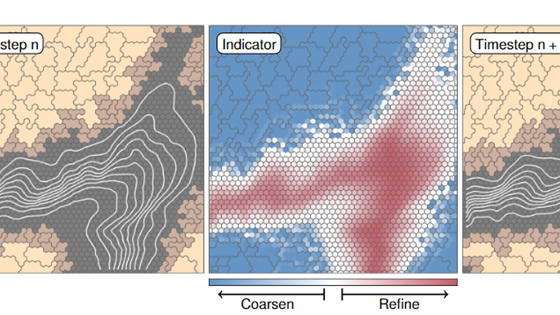
Multiscale methods, such as MsRSB initially proposed by SINTEF, have emerged to enhance runtime efficiency and pressure solve scaling in reservoir simulators using sequential splitting. Starting from the methods successfully implemented in the...
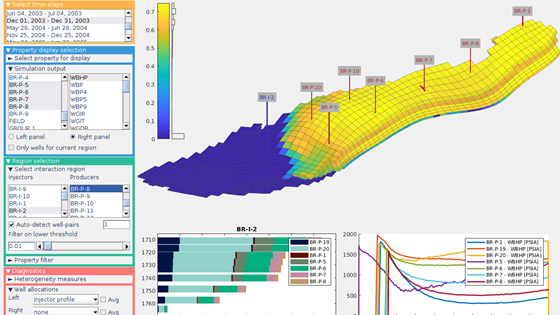
The primary objective for the project is to contribute to increased recovery from the NorwegianContinental Shelf by developing new flow-diagnostic methods that reduce the turnaround time to design andoptimize waterflooding and water-based EOR schemes
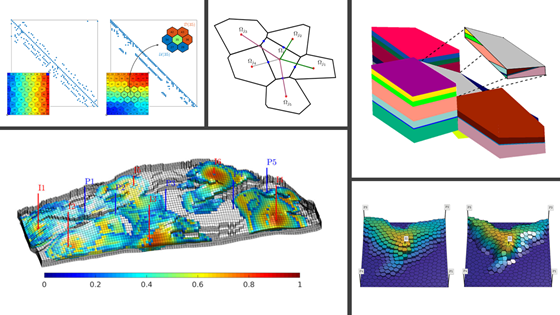
We study and develop numerical tools that can be used to improve the resolution of EOR simulations and, in particular, capture accurately the impacts of the injected chemicals on the recovery process.
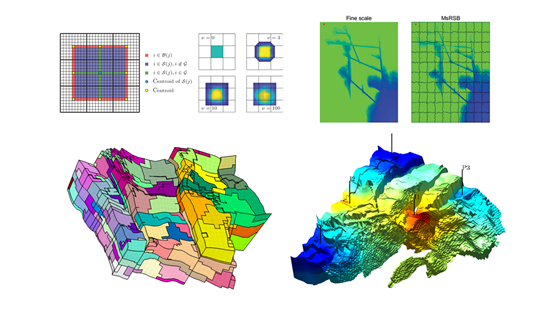
This project strives to broaden the scope of multiscale technology by delivering substantial acceleration to conventional reservoir engineering workflows. By doing so, it not only facilitates a considerable speedup in traditional processes but also...
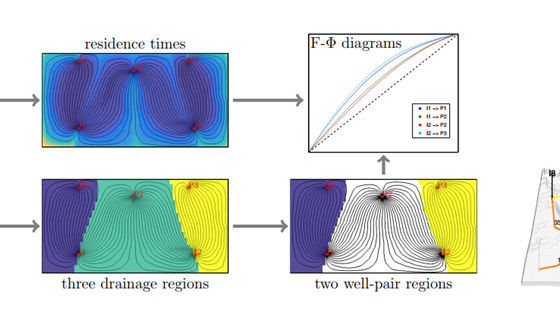
Modern reservoir simulators provide detailed forecasts of hydrocarbon recovery based on a description of the reservoir, the fluid dynamics, well controls, and couplings to surface facilities. In model-building workflows it is often desirable to...
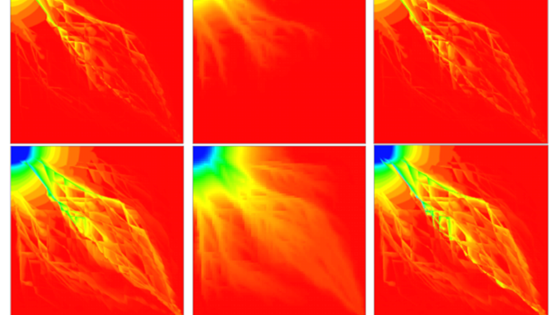
The purpose of the project is to develop a prototype multiscale mixed finite-element pressure solver in the ECLIPSE FrontSim streamline reservoir simulation software. FrontSim is a three-phase, 3D simulator that models multiphase flow of fluids along...
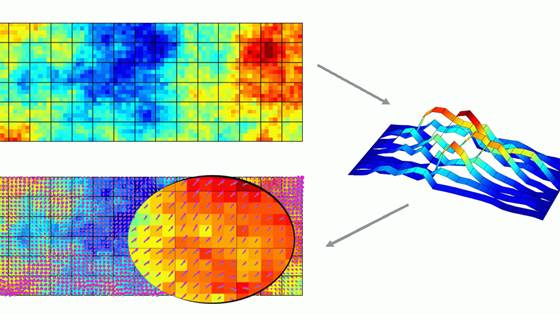
Modern methods for 3D geological modelling and reservoir characterization are leading industry to routinely build very large and detailed reservoir models; grid models of the subsurface geology currently range in size from 10 to 100 million cells and...