The prototype lets AI agents work alongside domain experts all the way from seismic interpretation to reservoir simulation. The agents assist, answer questions across fields, and link the disciplines together.
The result was shown at IMAGE, one of the world's largest conferences for applied geoscience and energy.
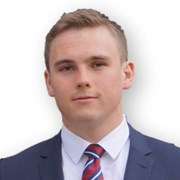
"It was very motivating to work so closely with industry," says Åsmund Mjøs, who is now starting his fifth year of the Physics and Mathematics programme at NTNU, specialising in applied physics.
AI agents bridge the disciplines
Picture three specialists working on the same oil and gas field. The geophysicist interprets the seismic data and maps the subsurface. The geologist builds a model of the rock formations. The reservoir engineer calculates how oil, gas and water move. They work on the same field, but use different terminology, data and software.
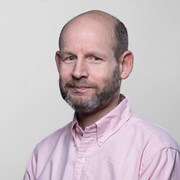
"Today, much of the information has to be passed from one specialist to the next. Each time, data and concepts must be translated between different technical languages. It is like having three different dictionaries, but only being able to look things up in one at a time," says Jakob Torben, research scientist at SINTEF and supervisor for the students.
The language models behind tools like ChatGPT and Claude handle the technical language of all three fields. What they lack is the ability to operate the specialised software and data formats each field relies on, and to connect them into a single workflow. That is where AI agents come in, he explains.
"An AI agent can use the language model to fetch information from several programs and disciplines and combine it. It can also take care of the actual work between the specialist programs: setting up models, running simulations and extracting results. A geophysicist can, for example, get an answer to a reservoir engineering question while the interpretation is still in progress and can still be changed."
This was the possibility that summer students Åsmund Mjøs and Vetle Støren explored at SINTEF. They built on SINTEF's own software and connected it to tools from Geoteric. The goal was to tie interpretation and simulation more closely together, so that specialists can work faster and more across disciplines.
Taught the AI agent to understand the disciplines
"If we continue the dictionary metaphor, our job was to feed the agent with data and train it in how to look things up in the different dictionaries," says Mjøs. He emphasises that they worked closely with experienced researchers in SINTEF's Department of Mathematics and Cybernetics.
"I am very glad we had so many people to ask for advice, and it was great fun to work in an environment with so many genuinely curious and skilled researchers," he says.
At the start of the summer, the students spent a lot of time understanding the field the AI agent would navigate. Among other things, they had to get to grips with reservoir simulation, which is used to calculate how oil, gas and water move in the subsurface.
The students combined this with seismic data from Geoteric. The platform was tested on a publicly available dataset from Australia.
"The goal of the agent is to be able to control simulations of different scenarios in natural language. You can, for example, ask the agent: 'How much of the water we pump into this injection well ends up at each of the production wells?' The answer might then be that one production well receives 60 percent, while two others receive 25 and 15 percent," explains Støren, who is in his third year of the Industrial Mathematics programme at NTNU.
Mjøs was also a summer student at SINTEF last year. Back then, he asked for tasks that were particularly relevant to mathematics and physics.
"This assignment confirmed that SINTEF took my thoughts into account, and that means a lot. I feel the feedback I gave last year was listened to," he says.

From prototype to the world stage in Houston
The students were thrown into an important delivery. The platform was to be demonstrated at the IMAGE conference in Houston, which started on 17 August, and the prototype had to be ready before departure.
Torben believes they could give the students such a large responsibility because the level of applicants for the summer jobs is high.
"With applicants this good, we have high expectations. On top of that, coding agents let a small team build far more in one summer than was possible just a couple of years ago. AI agent technology is something many young people know well, and we are now exploring new ways of working with this technology," says Torben.
The project was completed in record time, and Geoteric got the opportunity to show how AI agents can connect specialised tools in geoscience.
"I am convinced that open AI agent platforms will change the way geoscientists work," said Jan Grimnes, chairman of the board at Geoteric, in a press release earlier this summer.
"The opportunities lie not only in automating individual tasks, but in getting specialised tools to work together to test alternatives, make uncertainty visible and give decision-makers a better basis. That is what we want to show together with SINTEF," said Grimnes.
Can be transferred to batteries and carbon capture
The technology the SINTEF researchers developed for geoscience can also be used in entirely different areas. Research Manager and Chief Scientist Knut-Andreas Lie says that SINTEF already has experience with AI agents in areas such as geothermal wells, batteries and carbon capture.
He points to the winter of 2025/2026 as a turning point for AI agents. The models had become powerful enough, and the frameworks that control them were finally adapted to what the models could actually do.
"Only then did the agents become truly independent. They could use specialist software, work over longer periods and solve complex tasks with less help from humans," explains Lie.
AI agents can thus take over more of the manual work with files, programs, results and adjustments. Lie and his colleagues believe the development is still in its early stages, and that we have only seen the beginning of how AI agents will change the way we work.
"Much of what we developed in this project is transferable to other fields. The path from an experiment with data in a lab to an actual digital model of, say, a battery could become much shorter with this kind of technology," Lie concludes.
SINTEF Digital has expertise in reservoir simulation and more than 20 years of experience developing open-source software, including the reservoir simulator JutulDarcy, which was used in this project. Want to know more about the research group behind this technology? Contact the research group Applied Computational Science.