As Europe burns, many cities are trying to cut emissions, upgrade buildings, and rethink how energy is produced and used.
However, there is a recurring challenge: getting people to participate and accept the solutions to bring about the transformation. From this perspective, community engagement is often described as the weakest link in sustainable urban development.
A new study proposes a practical solution. By studying six neighbourhood transformations across Europe, the researchers have developed a simple and practical method to help planners, municipalities and developers work with people – rather than around them.
“If we want real change, we have to put people at the centre,” says research scientist Caroline Cheng at SINTEF. “Their needs, experiences and everyday lives are not just context. They are the baseline for innovation.”
Why neighbourhoods are so hard to change
Cities are responsible for a large share of greenhouse gas emissions, and upgrading buildings is one of the most effective ways to reduce them. But doing deep renovation at the scale of entire neighbourhoods is complex.
It involves many actors: residents, municipalities, housing companies, engineers, energy providers, and they often have different priorities.
At the same time, solutions like solar panels, district heating, or storm water treatment directly affect people’s homes and routines. Without trust, understanding and acceptance from neighbourhood residents, even the best technical solutions can fail.
“We often assume that better technology will automatically lead to better outcomes. But without engagement, even the best solutions may never be accepted or used as intended,” Cheng explains.
Living labs: a promising idea that often falls short
One widely used approach is the “living lab” approach. These are real-world test environments where stakeholders collaborate to develop and try out new solutions.
In theory, living labs are ideal for bringing multi-stakeholders together. In practice, they often struggle.
Research shows that many living labs fail to involve citizens meaningfully, if at all.
The problem is not the idea, but the lack of clear and easy-to-implement guidance on how to actually run the living labs. Amongst the many definitions, frameworks and ambitions, there is little practical advice. That’s the gap Cheng and her colleagues set out to fill.
Six neighbourhoods, one common lesson
The researchers analysed living lab projects in six neighbourhoods in Oslo, Palma de Mallorca, Karviná, Utrecht, Trento and Sønderborg. These projects are part of the EU-funded H2020 Green Deal ARV project, which aims to create “climate positive circular communities”.
The living lab projects varied widely – from renovating social housing to transforming schools and healthcare centres. Despite their differences, they revealed a consistent pattern: engagement works best when it is focused on target groups.
In Oslo, for example, long lectures about sustainability failed to engage students. But interactive workshops and digital tools helped to draw out their input and thereby strengthen their understanding of complex concepts such as “climate positive circular communities”.
In Karviná, which was once a thriving mining town, workshop excursions to closed mines helped the youth gain a practical appreciation of technical renovation solutions in the context of the overall energy transition from fossil fuels to positive energy districts.
In Trento, using the local dialect and familiar communication channels helped build trust with elderly residents. And in Palma, involving residents from low-income groups directly in the renovation work – supported by volunteer architects and building engineer professionals – not only reduced costs but also strengthened a sense of belonging to the community.
“There is no one-size-fits-all solution,” says Cheng. “What works in one neighbourhood may not work in another. You have to understand the social context deeply, as deep renovation on a neighbourhood scale is a place-based initiative.”
The S.M.I.L.E. method: a simple roadmap
Based on these experiences, the researchers developed a five-step approach called S.M.I.L.E.:
- Scope – Understand the community and identify key groups
- Map – Identify all relevant actors and their interests
- Implement – Carry out engagement activities
- Learn – Evaluate what worked and what didn’t
- Enhance – Improve and adapt for the next round
The key insight is that engagement should be viewed as part of a continuous process rather than a single event or one-time intervention.
“We wanted to create something practical. An approach that helps people move from good intentions to actual action on the ground,” Cheng says.
Not everyone needs to be involved all the time
One surprising finding challenges a common assumption that more participation is not always better.
Instead of always aiming for maximum engagement, the researchers argue for having the right level of engagement at the right time. Some decisions require deep citizen involvement. Others may only need information-sharing or targeted input.
This more flexible approach can save time and resources and lead to better outcomes.
“It’s not about getting everyone involved in everything,” says Cheng. In other words, ‘the higher the level of engagement, the better’ is not the aim. Instead, it is more important to consider the right level of engagement at the right time for efficient allocation of resources.
It’s about people
Ultimately, the study highlights that sustainable neighbourhoods are not just about energy systems or building materials. They are about people. Long-term change depends on whether residents understand, accept and support new solutions, and whether they feel part of the process.
Cheng states, “Durable change has been achieved only when people’s hearts and minds, their values and cultural practices, and the quality of relationships they have, are transformed.”
A practical tool for a complex challenge
The S.M.I.L.E. methodology is not a cure-all. However, it provides a simple and structured approach to facilitating community engagement in complex urban projects, addressing a gap that has existed in the field.
Focusing on people first, and learning and adapting along the way, helps bridge the gap between ambitious climate goals and real-world implementation. As cities throughout Europe step up their climate efforts, this approach could provide the crucial missing link.
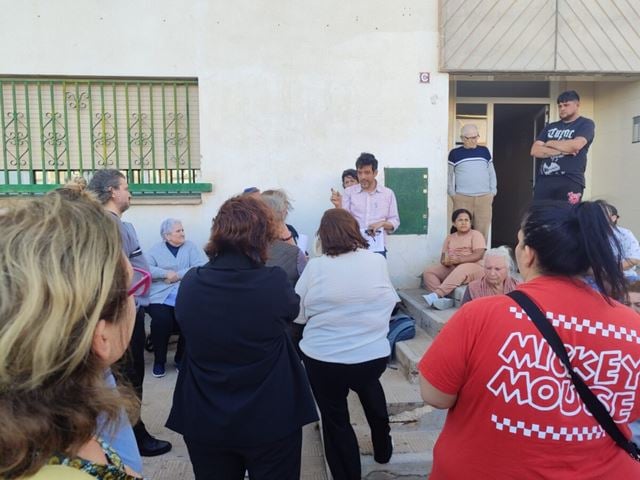
To make neighbourhoods more climate-friendly, residents must be involved in technological choices and solutions. Here, residents of Le Soledat neighbourhood in Palma meet a volunteer team of architects and engineers. Photo: ARV
Reference:
Caroline Cheng, Judith Thomsen & Anandasivakumar Ekambaram (2026): A Systematic Living Lab Approach for Community Engagement for Urban Regeneration – the S.M.I.L.E. Methodology