

Jutul
Experimental Julia framework for fully differentiable multiphysics simulators based on implicit finite-volume methods with automatic differentiation.

Simulations can stall or become prohibitively expensive when models are strongly nonlinear, physical processes operate on different timescales or couplings between subproblems are difficult to resolve. The choice of solver and time step is then critical to both robustness and efficiency.
We have particular expertise in nonlinear solvers for stiff and strongly coupled problems. Our work covers Newton-based methods and trust-region strategies, as well as methods that concentrate computational effort where it is needed most. Nonlinear domain decomposition and reordering of unknowns allow us to exploit model structure and reduce the need for expensive global iterations.
We can help you:
Contact our Applied Computational Science research group if you have a model that is difficult to solve, want faster simulations or need new methods for existing software.
Newton methods can converge rapidly when the iterates are close to the solution. However, they can also stagnate, oscillate or produce updates that lead to physically or numerically problematic states. We investigate how model formulation, initial guesses, scaling and control of the updates can improve the solution process.
Our work includes adaptive relaxation strategies and trust-region methods, which restrict updates according to where a local approximation of the problem is appropriate. We have developed methods that use information about flux functions and local couplings to guide Newton iterations in multiphase problems.
We also develop convergence monitors that detect unfavourable behaviour early. Information from the iterations can be used to adjust the solution strategy or terminate an unpromising attempt and retry with a shorter time step.
Many discretised models have a dependency structure that can be exploited to solve the equations in a favourable order. For transport problems, this structure can often be determined from the direction of flow between computational cells.
We have developed reordered nonlinear Gauss–Seidel methods that follow these dependencies. When the system can be put into triangular form, it can be solved through a sequence of local nonlinear solves without repeated global iterations. Mutual dependencies are handled by grouping unknowns into coupled blocks.
Reordering makes it possible to concentrate nonlinear solution effort where it is actually needed. We have combined these methods with higher-order discretisation, local time stepping and adaptive coarsening for efficient simulation of transport in porous media.
Convergence difficulties may be confined to small parts of a large model. Nevertheless, they can force a global solver to perform many expensive iterations over the entire computational domain.
Nonlinear domain decomposition divides the model into subdomains that are treated with local nonlinear solvers. These local solves can be used to precondition the global problem, addressing difficult local behaviour before correcting the solution across the full model.
We develop and investigate Schwarz-based methods, adaptive combinations of Newton iterations and nonlinear preconditioning, and strategies for coupling subdomains. Our work addresses both robustness and efficient execution in parallel simulations.
A time step must be long enough to keep the simulation efficient, yet short enough to capture important changes and produce a tractable solution problem. Numerical stability, time-discretisation error and nonlinear convergence impose different requirements that must be considered together.
We work on implicit time integration, adaptive time stepping, local time stepping and error control. The aim is to adapt computational effort to where and when the model changes, and to avoid solving subproblems more accurately than necessary when other sources of error dominate.
Our background also includes research on exponential integrators and Lie group integrators. These methods exploit operator exponentials and the geometric structure of differential equations, respectively. This experience contributes to a broad foundation for assessing and developing time-integration methods for different classes of problems.
When several physical processes interact, all unknowns can be solved simultaneously or the problem can be divided into smaller parts. Fully implicit methods treat the couplings together, while sequential methods and operator splitting can offer simpler subproblems and greater flexibility.
We investigate how coupling strength, time-step selection and the properties of local solvers affect accuracy and convergence. Our experience includes coupled models of flow, transport, heat transfer and geomechanics.
Through collaboration with industry and software vendors, we have experience developing and testing these methods on demanding simulation models. We assess the complete solution process, including computing time, iteration counts, rejected time steps and the quality of the results.
Several of the studies below use reservoir simulation as their application. However, they address challenges that also arise in other simulation fields: strong nonlinearities, local convergence difficulties, coupled processes and multiple timescales. The work on exponential integrators illustrates our broader background in numerical time integration.
Experimental Julia framework for fully differentiable multiphysics simulators based on implicit finite-volume methods with automatic differentiation.

A free open-source community code for rapid prototyping of new methods for modelling and simulation of flow in porous media. Has a large user community from all over the world.

The Open Porous Media (OPM) initiative provides open-source software for simulation, upscaling and visualization of porous media processes, in particular subsurface reservoirs.
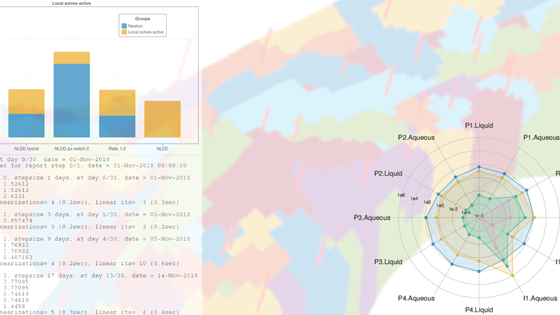
Reservoir simulation, an essential tool in the oil and gas industry for predicting reservoir behavior, often incurs significant computational expenses. This arises from the intricate nature of subsurface flow dynamics and the need for high-fidelity...
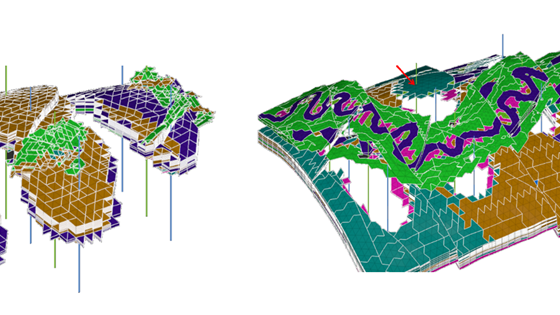
To optimize hydrocarbon reservoir recovery, understanding and predicting flow and transport processes is crucial. Geo-cellular models, representing complex rock formations, often contain millions of cells, requiring hours for simulation. To expedite...
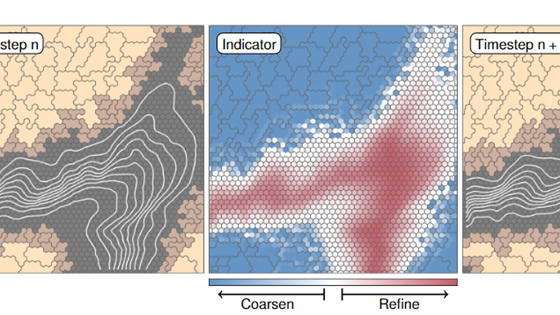
Multiscale methods, such as MsRSB initially proposed by SINTEF, have emerged to enhance runtime efficiency and pressure solve scaling in reservoir simulators using sequential splitting. Starting from the methods successfully implemented in the...
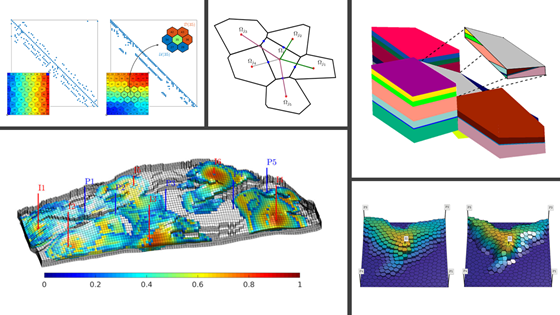
We study and develop numerical tools that can be used to improve the resolution of EOR simulations and, in particular, capture accurately the impacts of the injected chemicals on the recovery process.
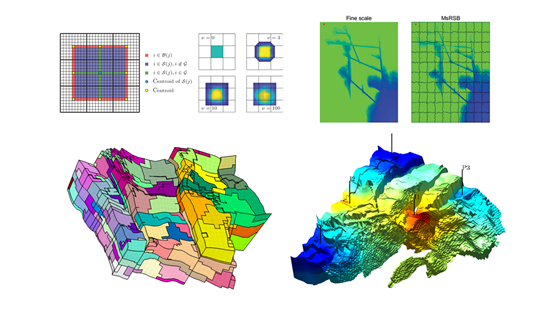
This project strives to broaden the scope of multiscale technology by delivering substantial acceleration to conventional reservoir engineering workflows. By doing so, it not only facilitates a considerable speedup in traditional processes but also...
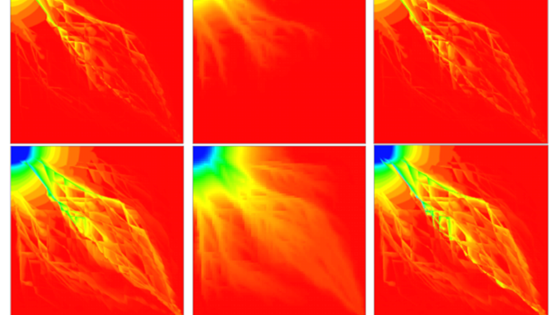
The purpose of the project is to develop a prototype multiscale mixed finite-element pressure solver in the ECLIPSE FrontSim streamline reservoir simulation software. FrontSim is a three-phase, 3D simulator that models multiphase flow of fluids along...