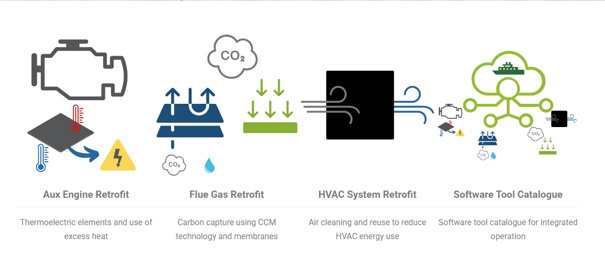
The Green Marine project (Green Marine) will develop retrofit protocols for existing ship fleets, create a software‑based tool catalogue, and demonstrate innovative technologies for carbon capture, energy efficiency, and reduced fuel consumption. These solutions will be tested on land‑based engines before being demonstrated on a waterborne vessel. The consortium consists of 10 partners from 7 countries, including 6 SMEs, 3 research institutes, and a major ferry operator.
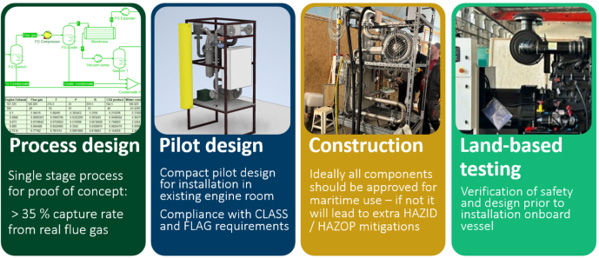
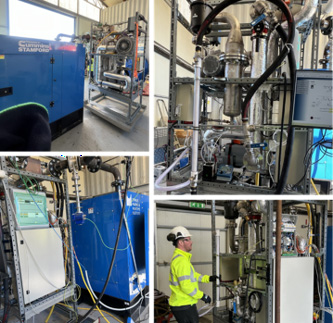
SINTEF’s role in the project is to develop a CO₂‑capture membrane pilot system designed for TRL 6 testing onboard a ship. Our work focuses on scaling up both flat‑sheet and hollow‑fiber membrane geometries from laboratory scale to small pilot‑scale modules, which will be tested using real diesel exhaust. Within the Green Marine project, we aim to demonstrate a CO₂ capture rate of 35% from diesel‑powered ships using a single‑stage membrane concept. In addition, theoretical studies will explore recovery rates of up to 90% through simulation models of multistage membrane systems.
Membrane separation is a promising decarbonization technology suitable for application on ships, where footprint, weight and space limitations are important design constraints to be considered. Membrane installations for CO2 capture can overcome the constraints imposed by ship operation and design due to the intrinsic simplicity of installation, modularity, low weight, and footprint. Cleaning diesel exhaust from ships imposes additional challenges represented by a low and variable 3- 8 % CO2 content depending on the ship, engine type and engine loading leading to a low driving force for separation.