As industry, infrastructure and society move into increasingly inaccessible and weather-prone areas, the risk and the need for accurate knowledge increase.
Many of the biggest challenges lie hidden below the surface – in snow, soil, ice and rock.
This is precisely where SINTEF deploys its drones with advanced sensors. They are equipped with radar, magnetics and cameras.
“Our goal is to provide a better basis for decision-making while reducing both risk and environmental impact. Drones make it possible to collect detailed data where it has previously been dangerous, time-consuming or impossible,” says researcher Madeline Lee.
Reveals avalanche danger and calculates electricity production
One of the key technologies is drone-borne ground penetrating radar (GPR). The radar sends electromagnetic signals into the snow or ground and provides a detailed image of the layers and structures below the surface.
Drones make it possible to collect detailed data where it has previously been dangerous, time-consuming or impossible.
In a collaborative project with the Norwegian Geotechnical Institute (NGI) and the Norwegian Public Roads Administration, SINTEF has used drones with ground penetrating radar to map the depth, moisture and risk level in the snow layers of Norwegian mountain areas.
The result is like an X-ray image of the snow layers over entire mountain sides, not just where snowpack profiles are taken.
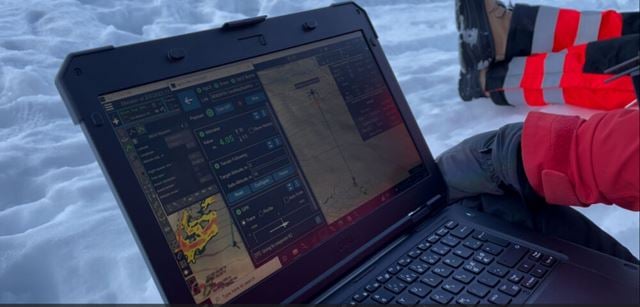
What is the avalanche danger here? The drone gives researchers X-ray-like images of the snow layers. Photo: SINTEF
“We can identify layers that are critical for avalanche danger, and we can do it repeatedly throughout the season along the exact same flight route. This provides completely new knowledge about how the snowpack changes over time,” says Bastien Dupuy, a senior research scientist at SINTEF.
The methods and technologies being used were developed by SINTEF and are of great value for several areas of society.
The technology provides a better overview of avalanche risk, without observers having to go out onto exposed slopes. For the power sector, more precise measurements of snowpack water content mean increased accuracy in forecasting spring floods and production planning.
In the long term, the methods can also provide important insight into how climate change affects snow conditions, melting and risk in mountainous areas and the Arctic.
We have both short- and long-range drones, and are now working on solutions that can stay airborne for a very long time, including using hydrogen cells.
Flying with heavy equipment
The drone platforms themselves are also being developed in SINTEF’s drone lab. Some are optimized for photogrammetry and high-resolution 3D models of terrain. Others are built to carry heavy sensors – up to eight kilograms – such as ground-penetrating radar and magnetometers.
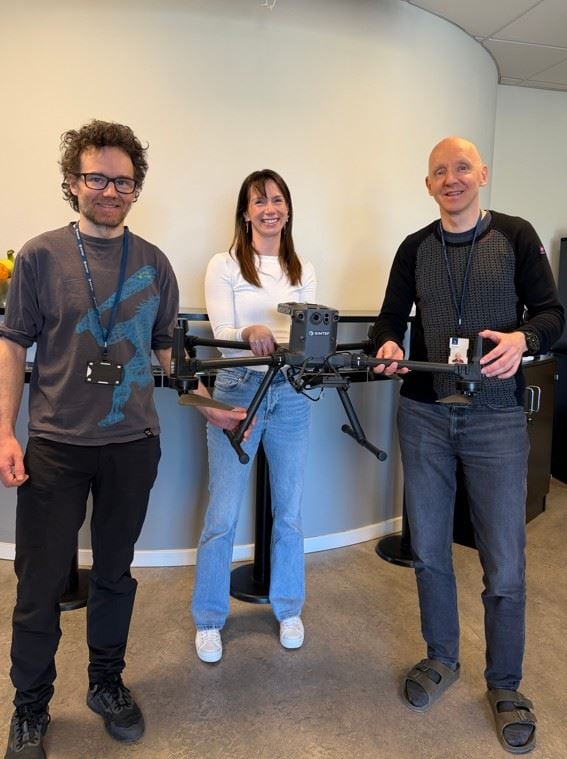
Drone researchers, from left: Senior research scientist Bastien Dupuy, and research scientists Madeline Lee and Arnt Grøver. Photo: Olav Spanne
“We have both short- and long-range drones, and are now working on solutions that can stay airborne for a very long time, including using hydrogen cells. This opens up completely new ways of monitoring large areas,” says Bastien Dupuy. “From snow and avalanches to pollution and war remnants.”
“We have both short- and long-range drones, and are now working on solutions that can stay airborne for a very long time, including using hydrogen cells.
The sensor portfolio doesn’t stop at radar. With magnetometers, the drones can also be used to map soil contamination, find metallic objects in the ground, or protect civilian populations by detecting war remnants. It can also be used to support mineral extraction and in construction projects.
- Here you can read more about the hydrogen drone that SINTEF is developing.
The common denominator for all the drones’ uses is the need for precise information in demanding environments – and the desire to reduce both risk and environmental encroachment.
The researchers are now working on automated interpretation of sensor data using machine learning, as well as more autonomous flight plans that prioritize areas with the greatest information value.
The goal is for drone-supported geophysics to become a robust and scalable tool for business, administration and emergency preparedness. To that end, the technology needs to be precise, safe and easy to use, say the researchers.
Curious? Take a peek into SINTEF’s drone lab: