Rough seas and rough net washing can lead to more microplastics in the ocean. Researchers have therefore been investigating how to mitigate these emissions by choosing better materials and methods for cleaning fish farming nets.
“Microplastic emissions are the result of complex interactions in material choices, a rope’s history of use and cleaning methods,” says Andy Booth, chief scientist at SINTEF Ocean.
Booth is the project manager for the FHF-funded SMARTER project. Tests undertaken in the project have revealed that certain types of recycled ropes and nets made of nylon, both with and without coating, appear to cause greater microplastic release than other rope types.
Net cleaning method plays a role
Farming nets are often exposed to fouling. The standard remedy is to wash the nets regularly, so the project also tested several cleaning methods.
Using a cleaning robot proved to be more gentle than traditional net washing and cavitation washing (a water jet that forms tiny bubbles that implode). The tests showed that the robot brushing caused less damage and more even wear on the coating.
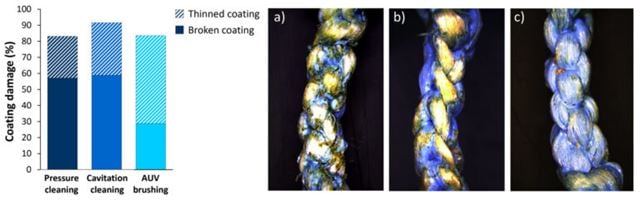
The blue coating was harder hit by net washing and cavitation washing (a and b). When using a cleaning robot, a thin coating remained, but the rope was much less damaged (c) Photo: Nina Bloecher, SINTEF.
“The nets are exposed to what we call mechanical stress that can cause them to shrink or wear. So cleaning them actually contributes to accelerating the release of microplastics,” says Booth.
He adds that microplastics are released when the nets wear out and break down over time.
“Plastic not only contributes to environmental pollution, but it can also contaminate seafood products,” says Booth.
Nets are often coated with wax, resin or acrylic-based products. This is done to protect against UV degradation, support cleaning-in-place (CIP) and reduce wear and tear.
The nets are exposed to what we call mechanical stress that can cause them to shrink or wear. So cleaning them actually contributes to accelerating the release of microplastics.
The researchers observed from the project testing that used nets released more microplastics than new ones, especially in areas causing high wear. These areas tend to be just below the water surface and on the sea floor.
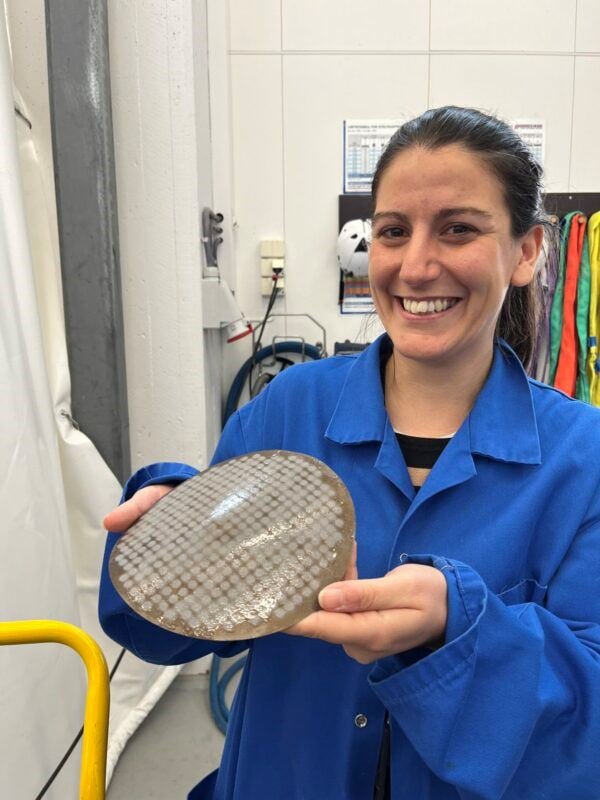
Stefania Piarulli is part of the research team. Here she shows a filter that was used to capture microplastics in the project. Photo: SINTEF
ScaleAQ sells equipment to the aquaculture industry and is now applying the project results that they have been a part of when making new purchases.
A lot of what we have tested is commercially available, so the aquaculture sector can already put their findings into use.
“Research has always been important to us,” says Øyvind André Haram, the Head of Communications at ScaleAQ . “We have to learn from the mistakes we make and apply new knowledge if we want to improve. The research on microplastics is generally still thin, which is why projects like this are very relevant. The research done here recommends making more use of HDPE nets, which is something we’re already working on. In addition, increasing the use of cleaning robots is recommended.”
Good start and solid basis for a new standard
Conducting sampling outside at the cages has been challenging, but the laboratory tests show that we can see clear differences between nets made of different materials. However, these tests are not representative of actual environmental conditions and the typical cleaning processes.
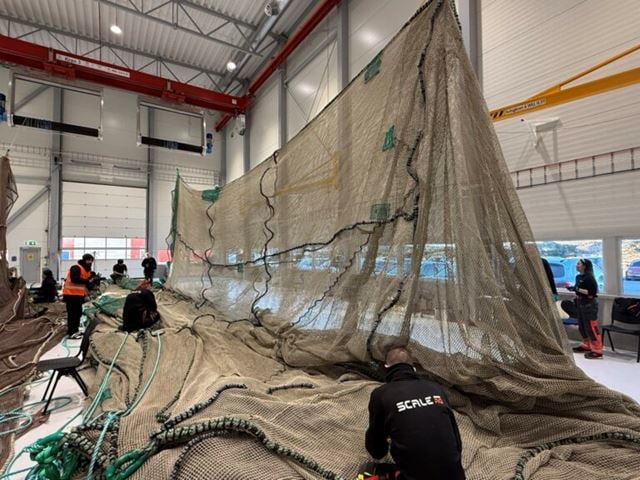
ScaleAQ manufactures equipment for the aquaculture industry at their premises on the island of Frøya. They are already applying the results from the project that they have been a part of when making new purchases. Photo: Øyvind André Haram
“When we tried to conduct field studies, the data basis became much less clear due to the complex test conditions,” says Booth.
Facts about the project:
SMARTER: SINTEF, NORCE Research, NCE Aquatec Cluster, ScaleAQ, Watbots and Brynsløkken have tested how nets and ropes made of different materials release microplastics and studied how different cleaning techniques affect emissions.
The project is funded by the Norwegian Seafood Research Fund (FHF).
The emissions data and project reports nevertheless form a solid basis for developing a new industry standard.
“A lot of what we have tested is commercially available, so the aquaculture sector can already use the testing results by incorporating SMARTER’s findings into procurement and maintenance routines to reduce microplastic emissions,” says Booth.
In the long term, SMARTER’s data should be expanded to provide a more robust and broader foundation that can support future innovation and environmental policy development in the industry. Several sustainability considerations should be taken into account when new regulations are developed.