Textile waste is a gigantic environmental and climate problem around the globe. In 2022, over 80 000 tonnes of textiles were thrown away in Norway alone. And the amount is increasing from year to year. The solution to the problem in the rich part of the world has long been to send textile waste to poor countries. Large amounts of discarded clothing are never reused and end up in landfills or incinerated.

Researcher Marianne Bakken at SINTEF
“Textile waste is a huge and complex problem. We have looked at just a small piece of the big puzzle,” says Marianne Bakken, a research scientist at SINTEF.
Only one recycling plant so far
Industrial recycling of discarded clothing is almost non-existent. The private company Norsk Tekstilgjenvinning (NTG) opened Norway’s first recycling plant in Sandefjord municipality in 2024. Clothes that cannot be used by the plant are broken down into fibres via a mechanical process. The fibres are sold to spinning mills to make yarn that is turned into new clothes. This applies to all types of textiles, including polyester and blended fabrics.
Accurate sorting is the key
NTG has collaborated with SINTEF on improving sorting technology. Good sorting is crucial for textile recycling to be effective. One tonne of textile waste often has 2 000 garments, made of many different fabrics and blends. Textile waste can also include bed linen, towels, curtains, upholstery and carpets.
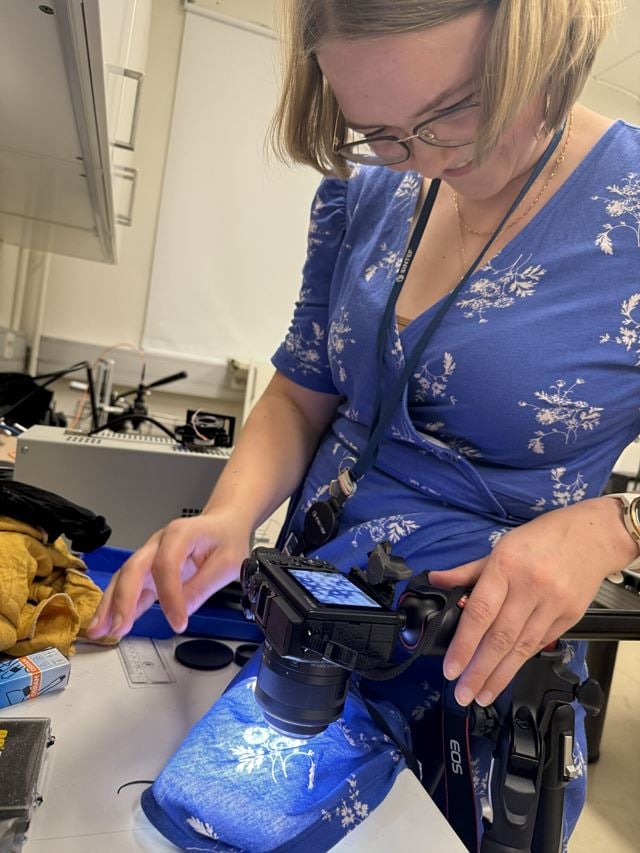
Doctoral fellow Vilde Vraalstad takes a picture of her own dress with an early version of the camera setup. Photo: Marianne Bakken/SINTEF
“We have completed a pilot project with promising results,” says Bakken.
“We set up a sensor system for the project with a camera that has extremely high resolution, almost at a microscopic level. Our thought is that linking the data from these cameras with artificial intelligence will enable the sorting process to reveal what kind of fabric we’re dealing with, its structure and the quality of the fibres.
Ripping textiles into fibre
Today, some of the textile waste is recycled into low-value products like rags, mats or insulation. A more precise sorting process would open up the possibility of reuse into high-value products.
“The recycling process requires good quality in to get good quality out. If you have accurate data about the textile’s structure and fibre quality, the machine that breaks down the textiles into fibres can be adjusted to yield the best possible result,” says Bakke.
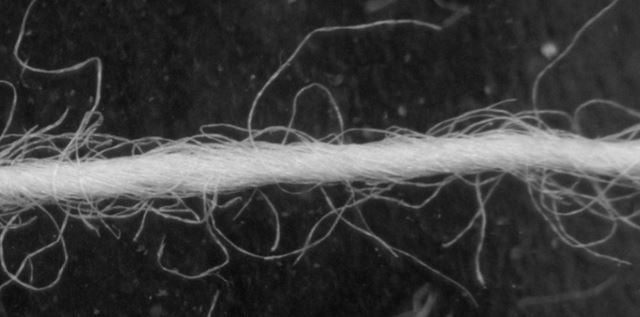
Example of a high-resolution textile image. The threads are approx. 0.2 mm thick. Photo: SINTEF
Accurate sorting is therefore necessary to end up with a higher quality of recycled fibre, so that more of it can be used to make new, high-value products. Better utilization of textile waste will increase profitability because spinning mills will pay more for good fibre.
Facts about textile waste:
Globally, 92 million tonnes of textiles were discarded in 2025 (UNEP).
More than 80 000 tonnes of textiles were discarded in Norway in 2022.
The clothing industry accounts for 8-10 percent of total CO2 emissions.
In 2022, nearly 30 000 tonnes of textiles were collected by private and non-profit organizations. Of this, only 909 tonnes were reused in Norway.
Approximately 49 000 tonnes of used textiles and textile waste end up in residual waste. Sorting analyses show that nearly half could have been reused, recycled or repaired.
Nearly 32 000 tonnes of textile waste were shipped out of Norway in 2022.
Cotton has a climate footprint of 11-16.4 kilograms of CO2 per kilogram of fibre, and high water consumption.
Polyester has a climate footprint of 1.7-4.5 kilograms of CO2 per kilogram of fibre, and is linked to the spread of microplastics (mostly ending up in landfills in African countries). According to worldbank.org, half a million tonnes of microplastic fibres are released into the ocean annually.
Starting 19 July this year, the EU and Norway require discarded textiles to be separated out from household waste. The EU will also introduce a system where manufacturers must pay for the collection and recycling of the clothes they make.
Fast fashion and ultra-fast fashion are apparel business models where manufacturers copy fashion and produce large quantities quickly and cheaply. The clothes are often of poor quality and have a short lifespan.
The UN Fashion Industry Charter (which many players in the clothing industry have joined) aims to halve the textile industry's CO2 emissions by 2030 (compared to 2019 levels). The charter also requires that the most common fabrics be recycled in a circular value chain.
Sources: 2023 Knowledge status for textiles and textile waste in Norway, NORSUS, (Norwegian Institute for Sustainability Research) and Norion Consult. earth.org.
Focusing on potential EU project
The pilot project has taken place in the laboratory and partly at Norsk Tekstilgjenvinning. The SINTEF researcher emphasizes that more work remains to be done to transfer the method to practical recycling when scaling up to large volumes that need to be sorted. The hope is to start an EU project.
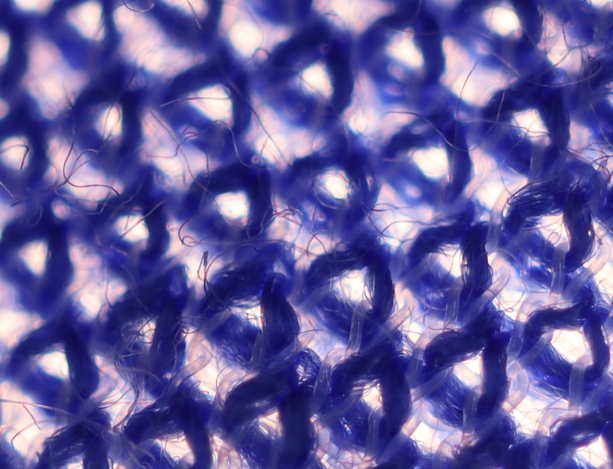
High-resolution image of the dress fabric showing two different types of threads and a knitting pattern that are not visible to the naked eye. Photo: SINTEF
“We need more experiments with different textiles and larger volumes. So far, we have used cameras and lighting that are off the shelf, and we’ve interpreted the images manually to find out which properties are possible to map. EU project funding would enable us to collect larger amounts of data and build algorithms using artificial intelligence.
Further development is the goal
Pål Erik Haraldsen, founder of Norsk Tekstilgjenvinning, is very interested in further developing the sorting technology.
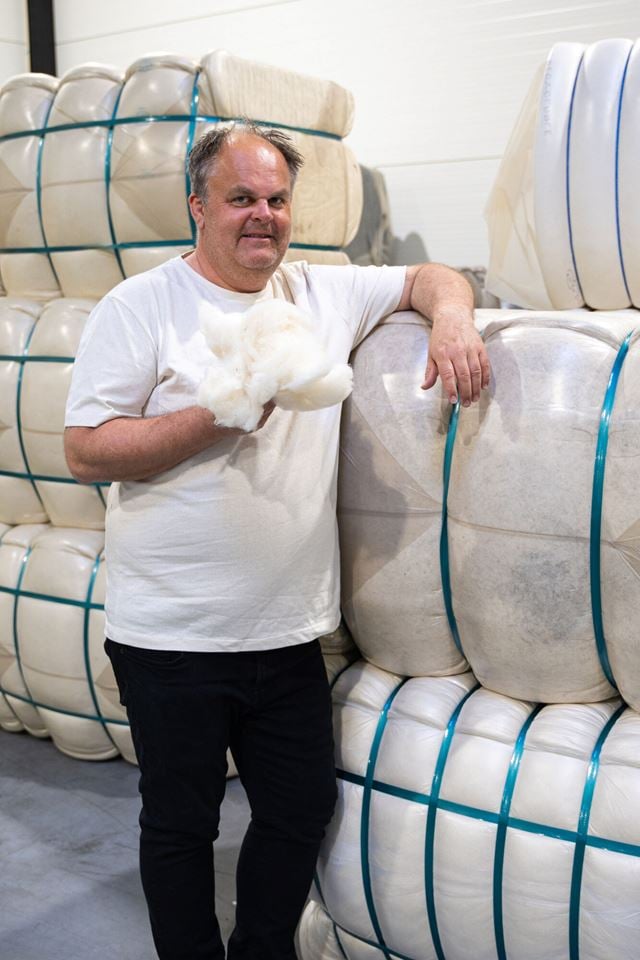
Pål Erik Haraldsen is the founder of Norsk Tekstilgjenvinning. Photo: NTG
“There’s huge potential in recycling more household textile waste. We hope we can continue what SINTEF has started,” says Haraldsen.
EU tightens regulations
The EU’s new waste directive will combat throw-away mentality and strengthen the recycling of discarded textiles. From 1 January this year, all EU countries and Norway must implement a sorting process ensuring that clothing does not end up in residual waste.
Starting in 2028, the EU will require manufacturers to cover the costs of collecting, sorting, repairing and recycling the clothes and shoes they make.
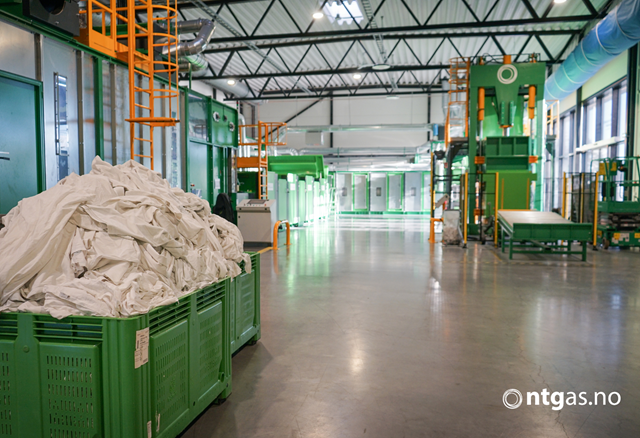
The premises of Norsk Tekstilgjenvinning, the only facility of its kind in Norway. Photo: My Linh Nguyen
Major change afoot
Facilities for industrial textile recycling have only just begun to emerge. Last year, NTG received 650 tonnes for recycling.
“The capacity can be scaled up to 30 000 tonnes annually – if enough money is invested,” says Pål Erik Haraldsen. The aggressive founder believes major changes in recycling are underway.
“International interest is showing strong growth. I think a lot could happen quite quickly, and we need it to. People are not exactly buying fewer clothes, and consumer numbers are on the rise.”
NTG estimates that recycling fibre will reduce CO2 emissions by 91 to 97 percent, as compared to purchasing new clothes.