According to the World Health Organization (WHO), more than one billion people worldwide are currently living with mental health disorders. Anxiety and depression are the most common conditions.
Being able to make a rapid diagnosis and finding the right treatment for people struggling with mental health issues is therefore crucial.
Sandra Klonteig, a research scientist at SINTEF, believes technology can help achieve this goal and has therefore focused her work on methods within neurotechnology, which make it possible to measure and better understand the brain. Neurotechnology can be used to influence or regulate brain activity, as well as for various forms of assessment and treatment—in cases of injury or brain disease, for instance.
“The brain is amazing, but not without flaws. It can be impacted by injuries and diseases that have serious consequences. Some people become paralysed, others develop dementia, and many experience mental health disorders like depression. Collectively, these conditions represent one of the leading causes of health problems in Norway,” says Klonteig.
“In the long run, this technology might enable doctors to detect changes in a person’s brain and mental health before the individual notices them. This could contribute to better prevention, an earlier diagnosis, and more targeted treatment of mental disorders.”
Using sensors and neurotechnology
Klonteig decided to delve into neurotechnology while pursuing her PhD at OsloMet. Today, she works at SINTEF Digital, where she conducts research on the human brain using precisely this type of sensor and neurotechnology.
Neurotechnology is a rapidly evolving field of research and is being studied from various angles. such as . Researchers are developing tiny chips that can be implanted in the brains of mice, testing new drugs for neurodegenerative diseases, studying the brain-gut connection, utilizing non-invasive measurements of brain activity, and employing artificial intelligence to detect strokes.
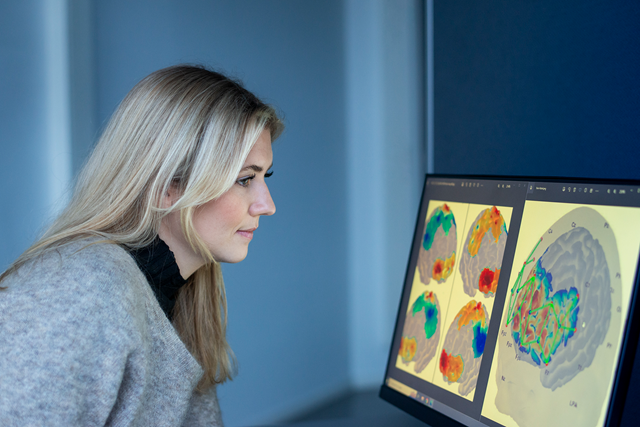
Sandra Klonteig examines analyses of fNIRS data, a technology that measures blood flow in the brain. This provides information on which parts of the brain are active and consuming energy. Photo: Sonja Balci/OsloMet
“Neurotechnology—and to some extent, AI—has long been associated with science fiction. Think of movies like The Matrix, where humans connect directly to digital worlds, or Minority Report, where technology interprets thoughts and intentions. Today, many of these technologies are no longer pure fantasy,” says Klonteig.
The dream scenario
Imagine visiting your doctor because you aren’t feeling well. After some brain examinations, you are told that the tests suggest a specific treatment that would be highly effective for you. A couple of weeks later, you return. You feel no improvement and are unsure if the treatment is working. At that point, the doctor might be able to tell you that your brain is already showing signs of change, even though your symptoms haven’t improved yet.
“Biological changes can occur before clinical signs become visible,” says Klonteig.
But the opposite can also happen. Tests might show that the treatment isn’t having the desired effect and that it would be better to try something else.
“This is precisely where the greatest potential lies. If we can more quickly detect whether a treatment is working or not, patients could be spared weeks or months of uncertainty and unnecessary stress,” she says.
“But to reach that point, we first need to understand the brain mechanisms underlying mental disorders. These are the mechanisms that researchers are now trying to measure.”
Using advanced neurotechnology
The challenge is how to actually measure such mechanisms. Researchers say the answer lies in examining brain activity patterns in people with depression and anxiety, .
Eye-tracking, for example, is a method that can be useful for studying attentional bias (AB)—the tendency to focus one’s attention on the negative aspects of a situation. here.
“For instance, if you take a walk through the woods after watching a scary movie, some people might perceive the shadows as threatening, while others notice how the light penetrates so beautifully through the trees. Over time, the way we interpret our surroundings can help reinforce a negative spiral and lead to depression or other mental health challenges,” Klonteig says.

Sandra Klonteig works in the Health department at SINTEF Digital. Her background lies at the intersection of technology, neuroscience, and health. She conducts research on the human body and the brain using sensors and neurotechnology. Photo: Sonja Balci/OsloMet
Another approach involves measuring abnormalities in the brain’s functional networks—that is, how different areas of the brain collaborate and communicate with one another. These networks are linked to both cognitive and emotional functions.
“It isn’t realistic to perform invasive brain procedures on every patient, so using solutions like sensor-equipped headgear—so-called non-invasive technologies—is more practical. This is one of the areas we’re currently focusing on at SINTEF,” says Klonteig.
Below are some of the methods that can be used in this type of research:
- Eye-tracking: This technology records where we look and where our focus lies, usually when viewing a screen.
- Brain-on-chip: Nerve cells or small fragments of brain tissue are placed on a small chip that mimics conditions within the brain. This allows researchers to test how nerve cells react to a drug, for example. These reactions can be measured in various ways—such as using tiny electrodes to capture electrical signals from the cells, microscopes to observe cellular changes, or by analysing the surrounding fluid.
- Artificial intelligence (AI) and MRI scans: MRI stands for magnetic resonance imaging, a method used to create detailed images of the brain. AI can be trained to detect abnormalities in these images—such as signs of a brain tumour—often more quickly than humans can on their own.
- Cultivating nerve cells: Researchers use stem cells, which are capable of developing into many different cell types, and induce them to become specific types of nerve cells. This allows researchers to study how nerve cells function without having to extract cells from a living brain.
- fMRI is an abbreviation for functional magnetic resonance imaging. It is an advanced imaging technique used to map brain activity by measuring changes in cerebral blood flow.
- fNIRS stands for functional near-infrared spectroscopy. This technology measures blood flow in the brain, providing insight into where the brain is consuming energy.
- EEG stands for electroencephalography. This technology detects electrical impulses generated in the brain. The signals are amplified and filtered by the EEG device.
- These methods are used in conjunction with behavioural and psychological measurements. Combining multiple technologies is also possible, and the field is evolving rapidly.
Source: SINTEF/OsloMet
This story has generated significant public interest, prompting this update:
Klonteig currently has no ongoing research projects involving patient groups that are open for participation. If you are interested in clinical trials taking place at Norwegian hospitals, you can find information here: Helsenorge’s overview of clinical trials.
Patient organizations like Mental Helse and Hjernerådet (the Norwegian Brain Council) can share information about research projects and opportunities for participation.
Want to know more? You can also listen to SINTEF’s podcast about neurotechnology, Smart forklart (Smart technology explained, in Norwegian).