
Marine Minerals Webinar Series 2026. Session 4: Mineral Assessments at the Seafloor
Session 3
Contact person

Session 3: Polymetallic Nodules – Aligning Scientific Research and Industrial Realities
Polymetallic nodules are small, rock-like formations resting on the deep ocean floor. They form vast underwater fields of critical metals like nickel, cobalt, copper, and manganese that are essential for green energy technologies. However, collecting them is debated due to the risks of disturbing fragile marine ecosystems.
In this third session of the Marine Minerals webinar series where we brought together two powerful perspectives to explore the mining impact and sustainability of deep-sea nodule collection.
See the recording of the webinar:
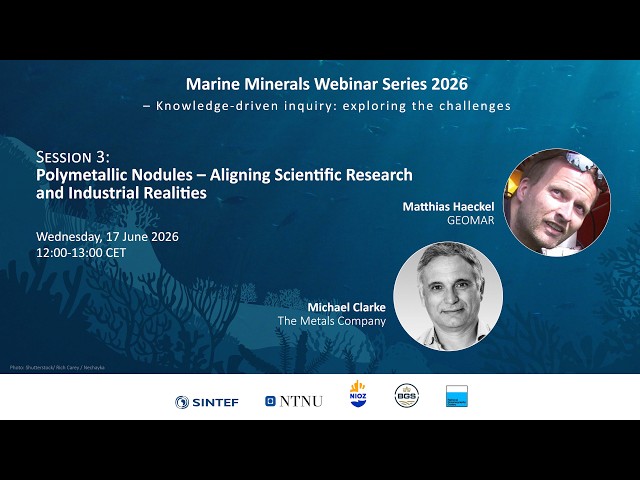
Featured speakers
Michael Clarke
Environmental Manager, The Metals Company
Michael Clarke has a PhD from the University of Texas and completed post-doctoral studies at Queen Mary University in London. He has 25+ years of experience in the field of environmental management and impact assessment with a focus on the mining and renewable energy sectors. With certifications as an Environmental Practitioner and Environmental Impact Assessor from the Environmental Institute of Australia and New Zealand (EIANZ), he has successfully delivered highly complex Environmental Impact Assessments for large infrastructure projects in all corners of the globe. Michael is also an accomplished marine biologist, he led a team to map marine turtle nesting and migration patterns on the northern coast of the Sinai Peninsula as part of a Darwin Initiative for the Conservation of Species project and has conducted marine conservation programs and baseline studies in Egypt, Indonesia, Vanuatu and Australia.
Matthias Haeckel
Dr. rer. nat., GEOMAR
Matthias Haeckel is a marine biogeochemist at the GEOMAR Helmholtz Centre for Ocean Research, Kiel. He holds a PhD in Natural Sciences from Kiel University. In his research, he combines sea-going fieldwork with numerical modelling and high-pressure experiments to entangle and quantify biogeochemical processes and how they are altered by anthropogenic uses of the ocean, such as deep-sea mining, methane hydrate exploitation, oil & gas production, sub-seabed CO2 storage. Since 2015, he has been coordinating the large collaborative European project Mining Impact on the environmental risks and impacts of deep-seabed mining.

Caption header image: SINTEF, Shutterstock/ Rich Carey / Nechayka