


BattMo
BattMo is an open source simulation code for continuum modelling of electrochemical devices written in Matlab and Julia

Simulation can help explain how electrochemical devices behave and how their performance depends on design and operating conditions. Answering new research questions often requires models and capabilities that are not available in existing software. We develop and extend simulation tools to meet these needs, with particular emphasis on lithium-ion battery cells.
We work with industrial partners and research organisations to:
Contact our Applied Computational Science research group to discuss a modelling challenge, a new simulation capability or improvements to an existing tool.
Our approach to rapid prototyping makes it easier to introduce new models and features, test alternative formulations and investigate interactions between physical processes. Flexible software allows models to evolve as research questions change.
We use automatic differentiation to compute the derivatives needed by numerical solvers and to support sensitivity analysis. Combined with adjoint methods, this provides an efficient basis for calculating how simulation outputs depend on model parameters. These sensitivities can guide parameter estimation and the optimisation of electrochemical systems.
Electrochemical behaviour depends on interacting processes that may need to be solved together. Our work includes high-fidelity models with more than one million degrees of freedom and fully coupled simulations of electrochemical and thermal behaviour.
Such calculations place substantial demands on numerical methods. We develop efficient solvers and preconditioners for the resulting equation systems and improve software implementation to make detailed simulations more practical. The aim is to achieve the accuracy needed for the application at an acceptable computational cost.
We are core developers of BattMo, an open-source framework for continuum modelling of electrochemical devices, particularly lithium-ion batteries. BattMo provides a platform for developing models, studying coupled processes and incorporating simulation into the design of new cells.
Open source code makes the model equations and numerical implementation available for inspection and extension. It also enables partners to build on shared software rather than start from scratch. The BattMo source code is available on GitHub.
We combine simulator development with SINTEF's expertise in battery technology. Close collaboration between modelling and experimental researchers helps direct software development towards relevant industrial questions and connects simulation with knowledge of materials, cell design and testing.
This combination supports the development of models that are useful both for understanding electrochemical processes and for investigating practical design choices.
BattMo is an open source simulation code for continuum modelling of electrochemical devices written in Matlab and Julia

DigiBatt will slingshot the European battery industry forward by using advanced digital technology to make battery testing faster, cheaper and more accurate. We will develop novel digital approaches to extract more value from fewer tests. This will...
Physics and data-based battery management by multi-domain digital twins (BATMAX) sets out to pave the way for advanced next generation adaptable battery management systems capable of fulfilling the needs and requirements of various mobile and...

Hydra will hybridize high-power and high-energy electrode materials to create sustainable Li-ion battery cells with excellent energy density.

HYDROGENi is a centre for environment-friendly energy research (FME) dedicated to the research and innovations within hydrogen and ammonia needed to meet the 2030 and 2050 goals of the Norwegian hydrogen road map.

Innovative and sustainable high voltage Li -ion cells for next generation (EV) batteries (IntelLiGent) will pave the way to sustainable European generation 3B Li-ion batteries with increased energy density (≥ 350 Wh/kg) by an optimized high voltage...
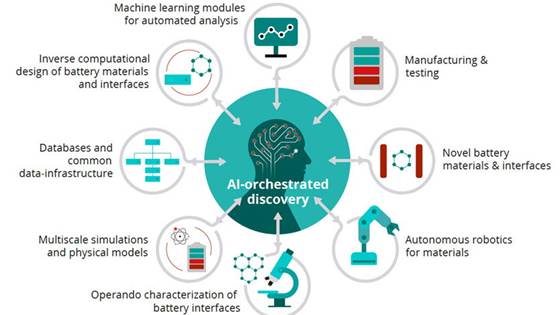
Batteries play an important role in our daily lives, powering smart phones, computers, and cars. As the world races to reduce CO2 emissions, the development of sustainable and high-performance batteries takes on an even more important role enabling...