


MRST - MATLAB Reservoir Simulation Toolbox
A free open-source community code for rapid prototyping of new methods for modelling and simulation of flow in porous media. Has a large user community from all over the world.

Where should wells be placed, how much heat can be stored, and how will temperatures evolve over years of operation? Simulation makes it possible to investigate these questions before construction and to assess changes to existing installations.
We work with industrial partners and research organisations to:
Contact our Applied Computational Science research group to discuss modelling a new installation, improving operations or developing simulation tools for your application.
Geothermal installations extract heat from the subsurface, while underground thermal energy storage allows surplus heat to be retained for periods of greater demand. Both require an understanding of how heat and fluid move through the ground, and how wells and geological conditions affect system performance.
Our work covers aquifer thermal energy storage (ATES), high-temperature ATES (HT-ATES) and borehole thermal energy storage (BTES). We also study systems in which flow through fractures has a significant influence on heat transport.
Through longstanding collaboration with industrial partners and researchers at the University of Geneva, we have developed open-source simulation software for these applications. This work draws on our experience in numerical methods and reservoir simulation, adapted to the challenges of heat production and storage.

Before construction, digital models can be used to compare well configurations, system dimensions and operating strategies. During operation, models can help interpret temperature and production trends and assess changes such as additional wells or a different seasonal balance between heat extraction and storage.
We develop technology to support digital twins in which physics-based models are updated using measurements and operational data. This includes model calibration, sensitivity analysis and optimisation, as well as connections between subsurface models, surface installations and operational constraints.
We also work with reduced models that allow many alternatives to be assessed quickly. The choice of model depends on the question, the available data and the decisions the calculations are intended to support. We can help adapt the tools and provide training in building and using the models.
Our software development builds on many years of experience with MRST. We extend this expertise through Fimbul.jl, a geothermal simulation toolbox written in Julia and built on JutulDarcy.jl and Jutul.
Fimbul combines efficient computation with differentiable models. This makes it possible to calculate how results depend on model parameters and control variables, and to use this information for model calibration and optimisation of design and operation. Open source code allows the methods to be inspected and the tools to be extended to new applications.
A free open-source community code for rapid prototyping of new methods for modelling and simulation of flow in porous media. Has a large user community from all over the world.

Experimental Julia framework for fully differentiable multiphysics simulators based on implicit finite-volume methods with automatic differentiation.

We develop digital solutions to advance geological heat storage as an eco-friendly, scalable energy storage method, reducing energy demand and supporting the green energy transition.
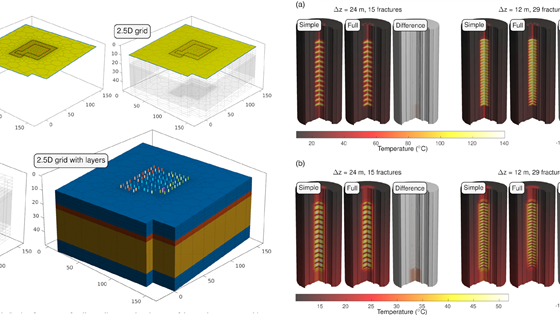
In this industrial innovation project, we combine numerical simulation and optimization to develop a digital platform for optimizing design and long term management of open, complex geothermal storage systems.