

As the world moves toward carbon neutrality, the recyclability of lightweight aluminium alloys becomes a key advantage. Recycling aluminium requires only 5% of the energy needed for primary production. However, producing large, defect-free billets from recycled-rich alloys remains a significant technical challenge.
The NextBillet project addresses this challenge by advancing low-pressure casting (LPC) through the integration of physics-based models and real-time, data-driven control systems. Recycled aluminium often contains impurity elements like zirconium, iron, and zinc, which can disrupt the solidification process. To understand their impact, the project combines laboratory experiments with solidification simulations to study how varying concentrations influence grain structure, crack susceptibility, and surface quality in the as-cast billets.
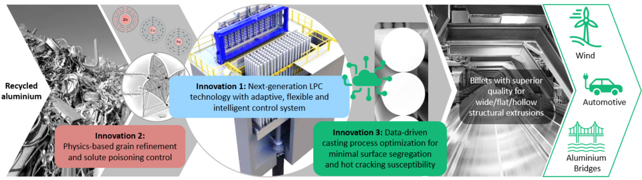
In parallel, the project deploys advanced sensor arrays to monitor temperature, pressure, and coolant flow within industrial moulds. These data streams feed into machine-learning algorithms trained to detect early signs of casting defects– such as hot spots, gas entrapment, or uneven solidification – and dynamically adjust process parameters. This adaptive control expands the LPC process window, enabling existing extrusion lines to handle recycled aluminium with fluctuating compositions.
NextBillet aims to produce high-quality billets suitable for extruding wide beams, turbine towers, and bridge girders – without the need for ultra-high-tonnage presses or blending with primary aluminium. Each tonne of recycled aluminium avoids new bauxite mining, slashes greenhouse gas emissions.
By combining advanced materials science with agile, data-driven process control, NextBillet is transforming recycled aluminium into a high-performance resource – laying the foundation for a circular aluminium economy and a more sustainable built environment.