Space is the primary challenge when implementing improvements offshore. For some platforms, electrification has served as a solution to secure clean electric power while simultaneously reducing emissions. However, this approach is not feasible for every platform.
Replacing gas turbines, recapturing power
Approximately 250 gas turbines are installed on Norwegian platforms, providing electricity for offshore oil and gas production. Some gas turbines have been replaced by power supplied from the mainland, but the availability of power and the distance from shore influence the choice of solution. Beyond generating electricity for operations and providing mechanical power for equipment like export compressors, these gas turbines also release vast amounts of heat—along with CO2—directly into the atmosphere via their exhaust.
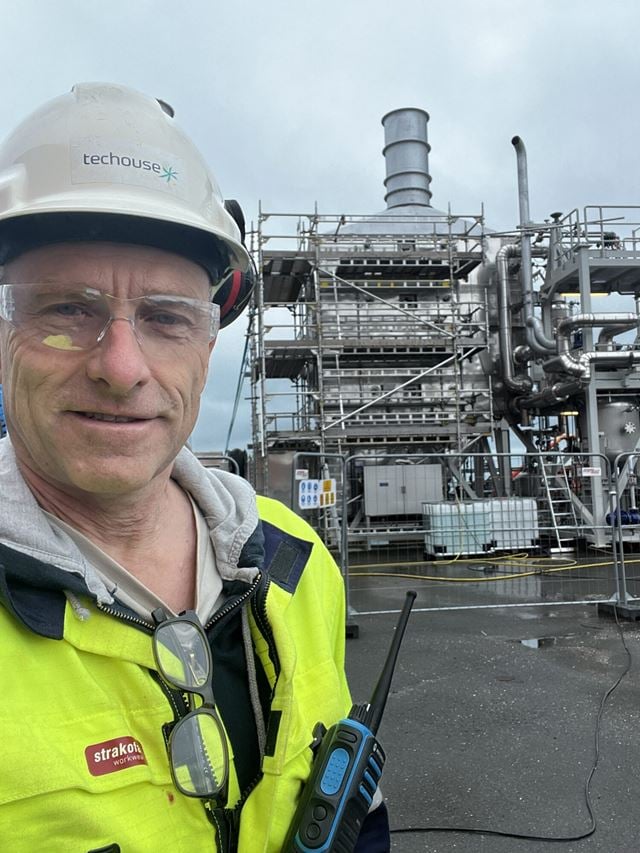
Pål Kloster from Techouse in front of the system. Selfie photo
On land, this issue was resolved long ago. Gas-fired power plants can capture exhaust heat, use it to generate steam, and then employ that steam to drive an additional turbine. Known as a “bottoming cycle,” this process yields significantly more electricity from the same amount of fuel consumed.
On offshore platforms, implementing a similar system has been virtually impossible, as the necessary equipment has simply been too large and heavy to fit onboard. Some of the older and larger platforms were able to adopt this type of combined-cycle power generation, installing bottoming cycles as long as a quarter of a century ago. However, platforms that still operate using gas turbines are now so cramped that there is no room to install such traditional bottoming cycles. They need to be redesigned and downsized.
Collaborating with the technology company Techouse, SINTEF researchers have developed a solution that allows this technology to actually fit onto these space-constrained platforms. The process has taken 15 years.
It’s all about size
In addition to being sufficiently small and lightweight, a heat exchanger on an offshore platform must be able to withstand extreme fluctuations in temperature and pressure. It needs to be both efficient and robust, while simultaneously being compact and thin.
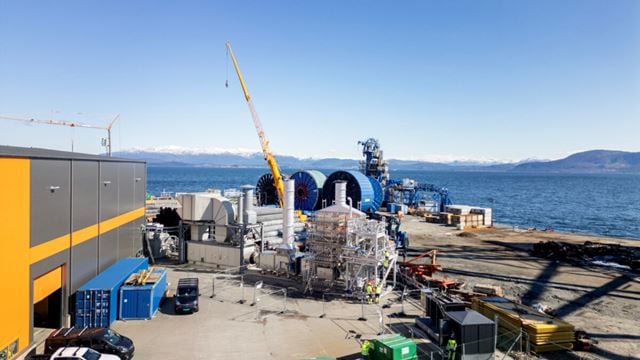
The system undergoes testing on Eldøyane, at the Alltec facility in Stord municipality. Photo: Pål Kloster
This means that every single detail in the design process—the choice of pipes, flow paths, and geometry—has a ripple effect on everything else. The researchers developed a dedicated tool for this specific purpose: a computational program called FlexHX.
The program allows researchers to simulate and optimize various configurations and designs on a computer before any physical construction takes place. But then comes the real test.
Thinner pipes, but need to be just as robust
To make the bottoming-cycle system sufficiently compact and lightweight, the pipes within the heat exchanger need to be thinner than the standard dimensions and packed more densely with fins, explains SINTEF researcher Ruben Mocholi Montanes.
“Fins” are the small ribs that increase the surface area where heat transfer occurs. SINTEF has already performed the simulations, but according to Mocholi Montanes, researchers had no prior operational experience with such thin-walled pipes. Consequently, there was a risk of increased vibration, which could cause equipment wear over time.
Another challenge is that the material is subjected to significant temperature fluctuations every time the system is started up or shut down—a process that can lead to increased fatigue over time. While simulations from previous projects identified potential weak points, the findings required validation through actual operation. Hence the need for a large-scale demonstration cycle.
Like a large house
Pål Kloster, CTO at Techouse, speaks enthusiastically about the demonstration facility:
“The demo plant at Stord is based on heat recovery from a 5 MW gas turbine—roughly 20% of the capacity of a typical offshore gas turbine.”
The heat recovery boiler matches the length and height of those used with typical offshore gas turbines, but its width is only 20–25% of the standard dimension. This allows for a realistic demonstration while ensuring the design can be easily scaled up to full size. A compact boiler of this type would be approximately 50% lighter and require about 15% less space than a conventional solution.
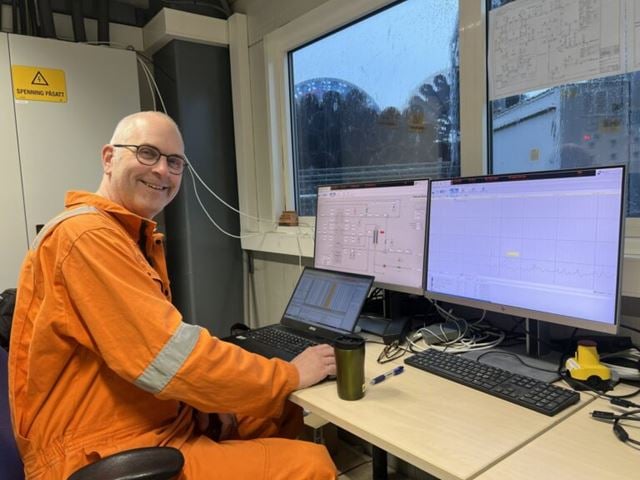
Full control: Kjell Ramsli of Techouse is pleased with what he sees at the control station. Photo: Pål Kloster
However, even though the facility itself is as large as a two-family house, the primary challenge remained: developing pipes that were sufficiently thin yet robust enough for the application.
“We succeeded,” says Kloster. “The pipes in the demo plant have a wall thickness of 1.65 mm, with welded-on fins measuring between 0.5 and 0.75 mm in thickness.”
Pushing the system to its limits
The system was more heavily instrumented than usual, with all data continuously recorded every second to allow for the analysis of the boiler’s performance and response. He adds that they also used high-speed filming to detect any potential vibration issues.
“We operate on the assumption that around 10 start-stop cycles per year are normal,” says Kloster. To simulate a 30-year service life, the boiler was started and stopped more than 300 times.
“Maintaining control over water and steam quality is absolutely critical for a steam system., Conductivity, pH, and oxygen levels were carefully controlled and monitored in the demo facility,” says Kloster.
The result? Zero leaks after 305 start-stop cycles, and the system handled the temperature fluctuations well. In other words, the testing was highly successful.
Solution can be used elsewhere
A thorough analysis of the raw data will be completed shortly. However, the tests already provide strong grounds for confidence in the thin-walled pipes, according to Mocholi Montanes.
“The vibrations are staying within safe limits,” he says.
“This means the technology can be deployed in various settings—for instance, on older platforms where space is limited, with little room to modify the existing layout.”
Facts about the COTSG demo project:
The Demo COTSG (Compact Once-Through Steam Generator) project is testing a new type of heat exchanger for offshore gas turbines. Owned by Techouse, the project is being carried out in collaboration with SINTEF Energy. Testing concluded successfully in August 2026 at Stord. Once installed on a platform, this technology can increase energy efficiency by up to 33 percent and reduce CO₂ emissions by up to 25 percent. TotalEnergies, Equinor, and ConocoPhillips are project partners. The industrial innovation project is being co-funded by the Research Council of Norway.