Nidaros Cathedral, Norway’s national shrine, is being fitted for new doors. The three large portals on the cathedral’s west front will be equipped with doors made of English oak (Quercus robur) from Denmark, painted red on the outside and decorated with wrought iron fittings and ornamentation.
Danish artist Fredrik Tydén designed the doors, which will be crafted in the Nidaros Cathedral Restoration Workshop (NDR).
But replacing the doors involves more than just going out into the forest and cutting down any oak and then hoping for the best. This type of wood is particularly rich in tannic acid that reacts with the wrought iron to be mounted on the doors. The tannins can also discolour the wood surface.
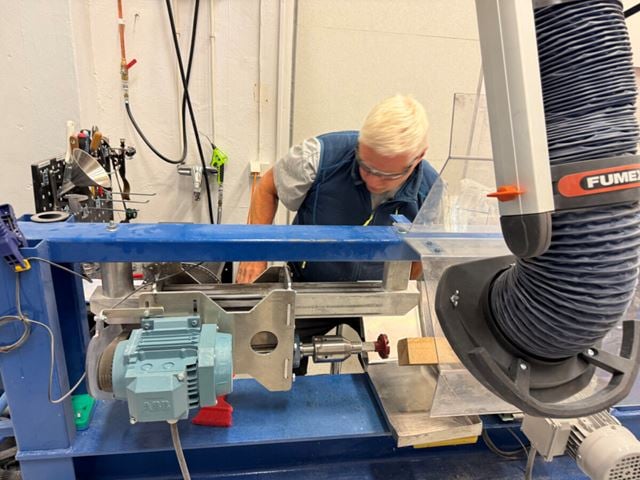
Here, senior technician Øystein Holmberget at SINTEF is milling samples of the oak that will be used in the new doors of Nidaros Cathedral. Photo: Jonny Tverdal
Some trees contain more tannins than others, depending on factors such as the growing location and climate, age and which part of the tree we are talking about.
Doors with a long-term guarantee
Each door will be around six metres high and weigh well over a tonne. This is not an ordinary exterior door we are talking about, and the quality must be the best possible.
“The quality is important when crafting doors intended to have a lifespan of several hundred years,” says SINTEF research manager Lars Gullbrekken.
Gullbrekken works with building materials at SINTEF, which has been commissioned by NDR to analyse the acid level in the oak, to ensure that only the very best parts are used and that the correct door surface treatment can be found.
“Acid damage shows up as black ‘rust’ on the wood, and the goal is for the doors to maintain their red colour,” he says.
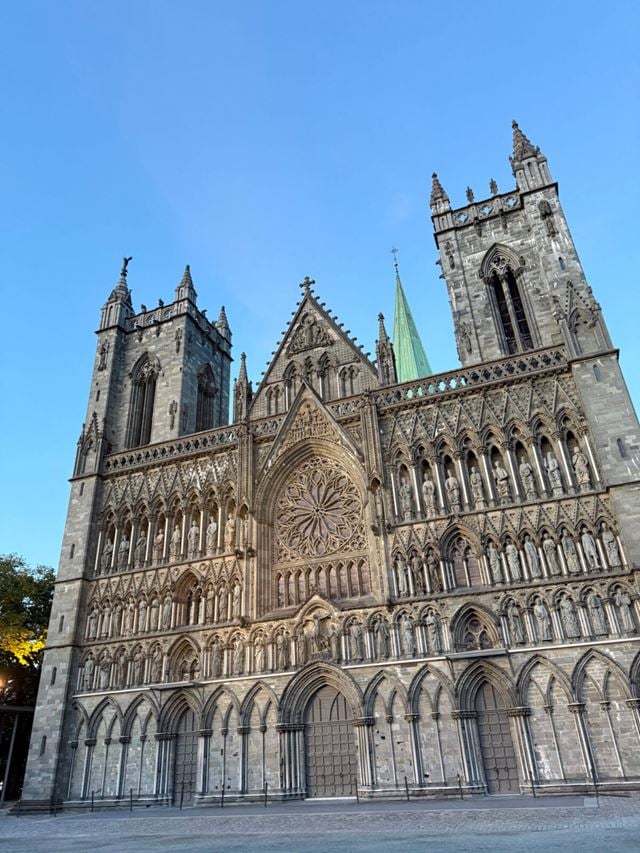
The new portals will replace the current grey portals on Nidaros Cathedral’s west front. Photo: Kathrine Nitter
Laboratory testing
Research manager Anna Nordborg and researcher Julia Halang are now analysing the oak pieces at SINTEF’s mass spectrometry laboratory in Trondheim.
“Nidaros Cathedral is a signature building for Trondheim, so being involved in this process is very exciting. It is an important building, and an honour to contribute to ensuring that the doors last a long time,” says Nordborg.
To determine the tannin level, the tannins from the oak are first extracted with alcohol to transfer them into a solution that can be analysed. Then a dye is added that reacts with the tannins so that the amount can be observed.”
Tannins function as a natural defence against fungi, bacteria and herbivores. They also help to strengthen the structure of the wood and make it more resistant to decomposition.

SINTEF researcher Julia Halang tests the oak in the laboratory. Photo: Ingvild Haugnes Aune
“There will always be a certain amount of tannins in oak, but once we know the level, we can figure out which treatment will work best. Alternatively, the wrought iron can be treated so that the two materials won’t react with each other,” says Nordborg.
SINTEF has also tested the tensile and compressive strength of the iron that will be used in the forged hinges.
A ground-breaking project
Both wrought iron and oak are well-known and traditional building materials. However, it is less common to combine them in the way that is planned for Nidaros Cathedral.
“I think it’s great that NDR and the technology community in Trondheim are coming together to share new knowledge about old methods and traditional materials,” says Marie Louise Anker, who is the director of cultural heritage protection at NDR.
“The work on the new doors of Nidaros Cathedral is a ground-breaking project, where we combine medieval sources and historical experiences with today’s most advanced analysis methods. The goal is to be confident that the solutions we choose will last ‘in eternity,’” she says.
What did the original doors look like?
Today’s simple, grey-painted portals were created in 1930 as a temporary solution in connection with the 900th anniversary of the death of St. Olav. What was intended to last for just a short period has now remained standing for an entire century.
The cathedral has been exposed to several major fires (including in 1328, 1531, 1708 and 1719), which destroyed much of the original interior and furnishings. The west front was significantly restored and later rebuilt in the 19th and 20th centuries, but the medieval doors were already gone when the restoration began.
Nevertheless, we can make an educated guess about what the doors most likely looked like, based on European cathedral doors and traces in the masonry.
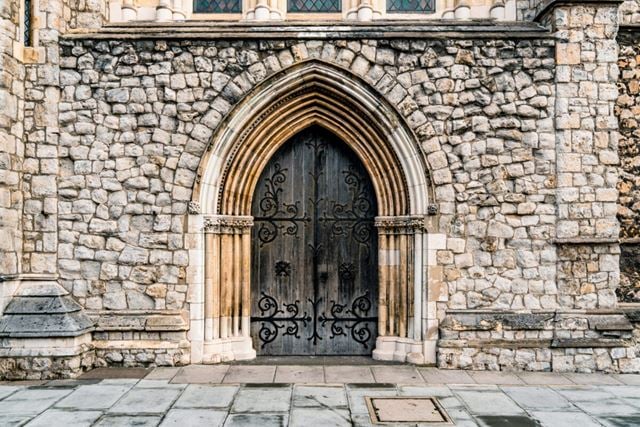
Perhaps the original doors once looked something like this? This door belongs to a church in London, built in the Gothic style. Photo: istock/ Chunyip Wong
The doors were probably constructed of heavy oak planks, as for other Gothic cathedrals in Northern Europe. They may have had wrought iron fittings that were both functional and decorative. These features are in line with the Norwegian medieval tradition and with traces of hinges and fasteners in the stone portals.
The west front had three portals as it does today, and each of these would have had heavy, double-leaf wooden doors. They were probably dark in colour, either tarred or naturally aged oak.
Medieval church doors were often richly decorated with Christian symbols, but there are no descriptions of the decoration on the original doors of Nidaros Cathedral.
Medieval meets modern poetry
Now the doors will once again be richly decorated, with respect for their cultural history. When announcing the winner of last year’s artistic competition, jury leader and art advisor Ida Højgaard Thjømøe praised the winning designer.
“Fredrik Tydén’s winning proposal distinguishes itself by combining the rich idiom of the Gothic with contemporary, poetic expression. The proposal shows a thoughtful combination of ornamentation, symbolism and craftsmanship,” she said.
New doors to be completed for the Norwegian National Jubilee in 2030
Tydén and craftsmen from NDR will collaborate in constructing the new doors.
They are planned to be completed in time for the National Jubilee in 2030, which marks the thousandth anniversary of the Battle of Stiklestad. This is where the Viking king Olav Haraldsson, later known as St. Olav, died. The year 1030 was a milestone for the formation and Christianization of the kingdom, and the emergence of Norway as we know it.
If you visit Nidaros Cathedral in 2030 and enter from the west side, know that you have likely passed through Norway’s most thoroughly tested doors. Thanks to modern technology and laboratories, generations after you will be able to do the same.