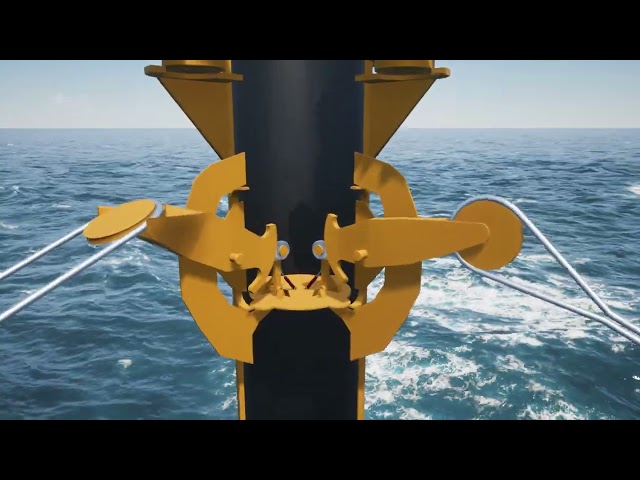
The Stavanger-based company Flex2Future has developed a modular concept, where each module consists of integrated wave energy converters, a wind turbine and solar panels. At full scale, a module measures 136 × 136 metres and, according to the manufacturer, has an average output of around 8 MW. This is estimated to cover the annual electricity consumption of approximately 4500 average Norwegian households*.
“Our system delivers power at a relatively low cost per kWh because it utilises three energy sources within a relatively small area,” explains Flex2Future CEO Erik Svanes.
The system can be connected to existing offshore infrastructure and relocated when needed.
Putting theory into practice
Even though the design has been assessed through numerical analyses, there is always an element of uncertainty for structures that are intended to operate at sea. This is where the test basins at Tyholt in Trondheim come into play.
In this case, a scaled-down model of the structure is placed in the ocean basin. Compared with the design drawings, the model may appear incomplete: a platform, a wind turbine tower without rotor blades, and no solar panels.
Nevertheless, SINTEF can test not only the ability to withstand large waves and rough seas, but also how wind and the movements of a wind turbine influence the its behaviour at sea – without as much as a breath of wind rippling the surface of the basin.
This is done using hybrid testing.

“At the same time as the wave makers operate according to predefined patterns to generate realistic sea conditions, we use wires attached to the structure at one end and sensors and motors at the other,” explains Project manager and SINTEF researcher George Katsikogiannis.
“We connect numerical models based on both weather data and decades of hydrodynamic expertise to the motors that pull and push the structure. This allows us to recreate realistic offshore conditions in the ocean basin.”

At the same time, a number of cameras and sensors record movements in the structures. How do they respond to different wind and wave directions? Can they withstand a winter storm in the North Sea? The data is collected and analysed.
“The results from the model tests can be used by customers such as Flex2Future to validate their numerical models, uncover unexpected motions and identify effects that cannot be predicted through simulations. This provides confirmation of the design and insight into how the system behaves,” explains Katsikogiannis.
“Put simply, the tests provide feedback on whether their numerical design and technical solutions are up to scratch.”
How to test power production – without power
Many of the same principles used to simulate wind conditions – without researchers and clients being blown over in the ocean basin – can be applied in the Towing tank to calculate energy production from the wave energy converters.

Here too, wave makers recreate realistic sea conditions. Wires, motors and numerical models are then used to test the potential power output from the integrated wave energy converters in the platform.
“This is the first time we have estimated power output in this way, using 10 motors controlled in real-time based on a range of signals from the measurement systems. In that sense, this is an example of how we develop and adapt our testing methods to the customer’s needs and requirements,” says Fredrik Brun, Senior engineer at SINTEF.
“I am very pleased and impressed by the multidisciplinary expertise,” adds Svanes from Flex2Future.
“And by how friendly and approachable everyone has been. How innovative and solution-oriented. And last, but not least, what you have managed to achieve with the power take-off (PTO) and energy extraction from the cube tested in the Towing tank – absolutely outstanding.
“It has saved us a great deal of time and gives us a very strong starting point for further development of the control system and testing of a full-scale PTO, which I hope we can carry out in collaboration with SINTEF. In short, a test programme that has delivered on every level.”
Norwegian ocean technology centre
In the new basins currently under construction at Tyholt, SINTEF will be able to carry out such tests more efficiently and with even higher quality. When the Norwegian Ocean Technology Centre is completed, SINTEF will be even better equipped to support the testing of concepts for the green transition.
Concept video from Flex2Future:
*Assumes that one household consumes 15,000 kWh of electricity per year. An average production of 8 MW corresponds to approximately 70,000 MWh per year – equivalent to electricity for around 4,500 households.