What we can help you with
How can a plant keep production and quality high while using less energy and raw materials? How do you control a process when key quantities are only measured a few times a day? Process plants such as metal and silicon production, chemical and fertiliser plants, biorefineries and hydrogen electrolysers face these questions every day.
We can help you with:
- Analysis of existing control systems and identification of improvement potential
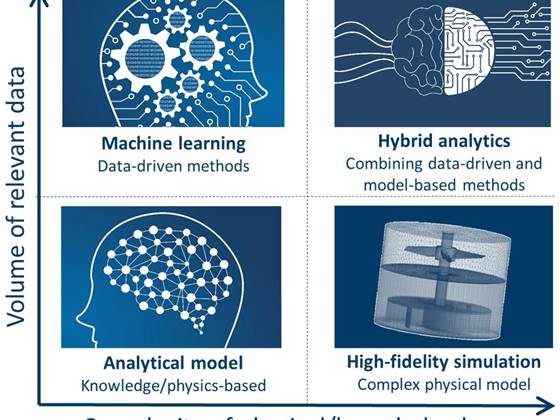
- Modelling of process dynamics, based on physics, data or a combination of both
- Estimation of unmeasured quantities, such as temperatures, compositions and process states
- Design, tuning and testing of controllers, from PID control to model predictive control (MPC)
- Data-driven optimisation of operation under changing conditions
- Feasibility studies, and preparation of research and innovation projects with public funding
From models to better control
Good control starts with understanding the process. We build dynamic models that range from first-principles models to data-driven and hybrid models, and use them for simulation, analysis and controller design. State and parameter estimation, such as Kalman filtering and moving horizon estimation, lets us reconstruct quantities that cannot be measured directly and keep models up to date as the process changes.
On this foundation we design control solutions that match the needs of the process, from well-tuned PID loops to model-based and optimising control. New solutions are tested in simulation before they are put into operation.
Machine learning in the loop
Many processes in the process industry are nonlinear and slow, have sparse and often manual measurements, and change over time due to wear and variations in raw materials. Here, traditional control methods are often not enough on their own. We combine machine learning with control theory, so that operational data can complement physical knowledge. At the same time, we focus on what can be guaranteed for stability and robustness, and on what data is required, so that the solutions can be trusted in industrial operation.
Optimisation and more autonomous operation
Optimal operating conditions change with weather, raw material quality, energy prices and production plans. We develop real-time and data-driven optimisation methods that adapt the operation of a plant as conditions change, while keeping the cost of experimentation and wear on equipment low. Together with digital twins and decision support for operators, this is a step towards more autonomous process plants.