We develop computational grids and numerical discretisations for complex geometries and physical processes. Our expertise spans structured and unstructured grids, from Voronoi grids and general polyhedral cells to locally refined, cut-cell and overlapping grids. We combine geometric flexibility with accuracy, conservation and computational efficiency.
Numerical simulation requires discrete representations of both the geometry and the governing equations. These choices determine which details a model can capture, how accurate the results are and how much computation is required. We develop grids and discretisations together, tailoring them to the physics and the intended use of the simulation.
We can help you:
Develop and adapt grids for complex geometries, material interfaces and thin structures.
Work with structured and unstructured grids, including Voronoi/PEBI grids and general polygonal and polyhedral cells.
Develop discretisations for flow, transport, diffusion, electrochemistry and mechanics.
Handle anisotropy, strong material contrasts, sharp fronts and irregular cell geometries.
Implement local refinement, adaptive methods and coupling between different grids.
Implement and verify numerical methods in existing or new simulators.
We have extensive experience with tetrahedral, hexahedral and prismatic grids, Voronoi/PEBI grids and grids with general polyhedral cells. Our work also covers corner-point grids, extruded grids, tree-based structures and combinations of different cell types. We develop our own methods and use established tools such as Gmsh where appropriate.
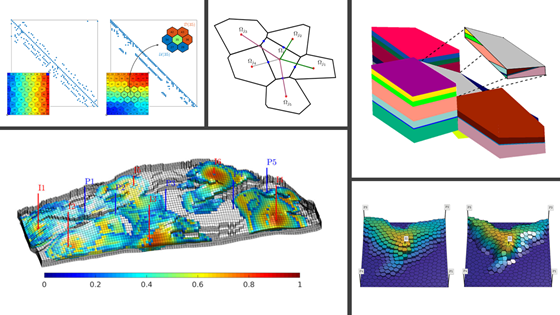
Different applications place very different demands on the geometry. Subsurface grids need to represent layers, faults and wells. For batteries, we have developed three-dimensional grids for wound electrode layers and separators, with thin material layers following a spiral structure. Other examples include terrain-adapted grids for water flow and overlapping grids for moving bodies.
We work on adapting cell faces, cell locations and local resolution to important geometric features. At the same time, the grid must provide a sound basis for computing fluxes, gradients and interactions between different parts of the model.
Geometry-adapted and cut-cell grids
A grid can be adapted to a geometry by aligning cell faces with interfaces or positioning cells along prescribed curves and structures. Voronoi/PEBI grids offer flexibility in combining these requirements with locally varying resolution. In cut-cell methods, geometric surfaces intersect a background grid, allowing the geometry to be represented without constructing the entire grid around it.
Our work on the UPR module in MRST demonstrates how unstructured grids can be adapted to prescribed geometric objects. These constructions require particular care where objects intersect and where adaptation produces small, slender or irregular cells.
Left: a cut-cell grid formed by intersecting a background grid with curved surfaces. Right: a Voronoi/PEBI grid adapted to well trajectories and faults.
Discretisations that preserve important physical properties
A discretisation translates continuous equations into a finite set of unknowns and algebraic relationships. We work with finite-volume, finite-element and discontinuous Galerkin methods, as well as mimetic and virtual element methods. The choice depends on the equations, the geometry and the properties the numerical solution needs to preserve.
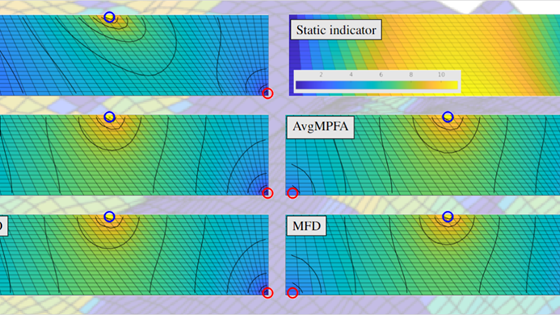
Local conservation of mass, energy or charge is central to many applications. Other important requirements include consistency, stability and the treatment of material interfaces. A method that works well on a regular grid may introduce substantial errors on skewed cells or when material properties depend strongly on direction.
We develop and implement multipoint flux and stress approximations, along with discretisations for general polygonal and polyhedral cells. We also investigate how consistency can be combined with monotonicity and appropriate maximum principles.
Transport, waves and sharp fronts
Transport and wave propagation place different demands on numerical methods than smoothly varying solutions. Fronts and discontinuities need to be resolved without excessive smearing or non-physical oscillations. We have long-standing experience with high-resolution methods for conservation and balance laws.
Our work includes Godunov and Riemann-solver-based methods, TVD and WENO schemes, central-upwind schemes and discontinuous Galerkin methods. For balance laws, we also work on discretisations that preserve relevant equilibrium states, so that small physical disturbances are not overwhelmed by numerical errors.
Applications range from water flow and waves to multiphase, multicomponent transport. We adapt methods to both structured and unstructured grids and to efficient implementation on modern hardware.
Local refinement, adaptivity and moving geometries
Resolution requirements are rarely uniform. Thin layers, local sources, sharp fronts and large gradients may require detailed computations in limited regions. Local refinement and adaptive methods allow computational effort to be concentrated where it is most useful.
We also have experience with multimesh methods, in which different parts of the geometry are represented by separate grids that can overlap or move relative to one another. This can reduce the need to regenerate the entire grid when the geometry changes. Coupling the subdomains requires appropriate treatment of interface conditions, stability and information transfer.
Multimesh approaches: a propeller and other moving bodies are represented by their own grids overlapping a background grid.
Methods that work on challenging grids
Practical models often contain cells with high aspect ratios, warped faces, small volumes or complex neighbour connections. These features can affect geometric computations, discretisation errors and the equation systems to be solved. We work on identifying and addressing these challenges throughout the computational process.
Reservoir models illustrate how demanding the combination of geometry and topology can become. Experience with these models provides a valuable foundation for working with general polyhedral grids and irregular connections in other applications.
Examples from reservoir models: degenerate and distorted cells, internal holes, high aspect ratios, varying cell dimensions and non-matching cell faces between neighbours.
From numerical methods to simulators
A general representation of grid topology and geometry makes it possible to use the same computational components across different grid types. We develop data structures and discrete operators that separate model equations from grid-specific details while making the necessary geometric information available to the discretisation.
This makes it easier to compare methods, couple physical processes and extend simulators with new capabilities. We assess methods through convergence studies, conservation checks and tests on representative geometries. The aim is to carry mathematical properties and practical performance through to the implementation.
The purpose of the project is to assist the client in the development of an industrial solution for multiphase and coupled flow-geomechanical simulations on unstructured grids representing structurally complex reservoirs.
We study and develop numerical tools that can be used to improve the resolution of EOR simulations and, in particular, capture accurately the impacts of the injected chemicals on the recovery process.