

Producing hydrogen directly from sunlight and water is an attractive route towards a sustainable energy future. However, the performance of today's photoelectrochemical devices is limited by fabrication methods that require long, energy-intensive heat treatments and may damage critical device components.
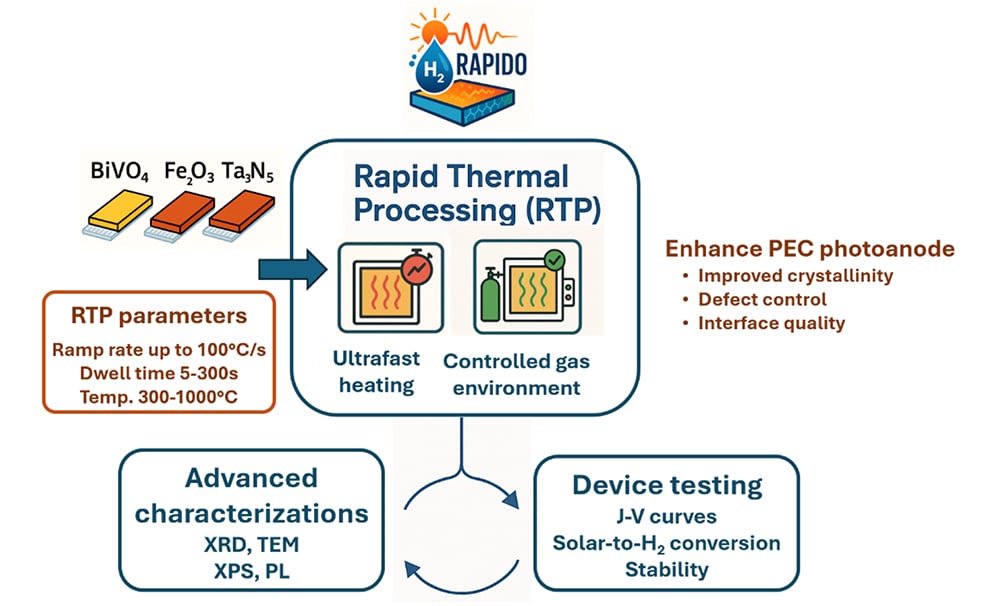
RAPIDO explores rapid thermal processing (RTP) as an innovative alternative to conventional annealing. By applying controlled heating and cooling rates over only a few seconds or minutes, RTP may enable new ways to improve the structure and performance of materials used for solar hydrogen production while reducing processing time and energy consumption.
The project focuses on advanced oxide and nitride semiconductor materials that act as photoanodes in photoelectrochemical water-splitting devices. Through the development of new RTP protocols, advanced materials characterization, and device testing, RAPIDO will establish how ultrafast thermal treatments affect material properties and hydrogen production performance.
The projects background
The transition to a sustainable energy system requires efficient and scalable methods for hydrogen production. Photoelectrochemical water splitting is a promising solution, but its development is limited by materials that are difficult to process and prone to degradation. RAPIDO addresses this challenge by developing new thermal processing approaches that can improve both performance and stability.
SINTEF leads the development of rapid thermal processing protocols and performs experimental work, including thin film fabrication, RTP treatments, and advanced materials characterization. The project also includes integration of optimized materials into photoelectrochemical devices and laboratory-scale performance testing.
- Learn more about our work in photocatalysis and photoelectrochemistry.
The project is coordinated by SINTEF in collaboration with the University of Oslo and international partners EPFL (Switzerland) and CEZAMAT (Poland). If successful, RAPIDO will provide new knowledge and manufacturing strategies that support the development of efficient and scalable solar hydrogen technologies.