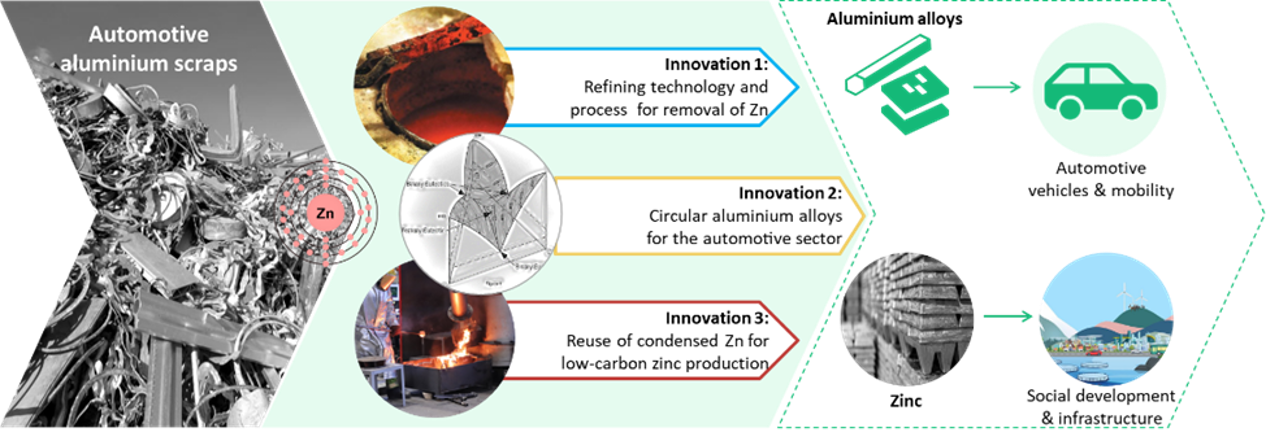
Europe aims to become carbon neutral by 2050. For the automotive industry, this means cutting CO2 emissions by 90 percent, and increasing the use of recycled materials is a key part of the solution. Today, however, little recycled aluminium from end-of-life vehicles is used in new car parts, because the scrap contains impurities that reduce quality.
REALUP will address the technical challenges of upcycling low-grade aluminium scrap from cars. The project is developing a new process to remove impurities such as zinc, enabling the refined aluminium to be used in new high-quality products. At the same time, the zinc will be recovered and used in other value chains.
The project has three main research areas:
1) Developing a vacuum refining process that efficiently removes zinc and other volatile impurities from molten aluminium scrap.
2) Understanding how residual elements affect the properties and processability of the aluminium, and developing new rolled aluminium products with at least 50 percent recycled content.
3) Recovering the zinc condensates from the refining process, mapping their composition and exploring possible applications.
REALUP is backed by a consortium of leading industrial players across the entire aluminium value chain. Zinc producer Boliden also participates and will investigate whether the zinc condensates can be used as raw material in its own production. SINTEF contributes experimental work and modelling of the vacuum refining process, as well as research on the relationship between scrap content and the microstructure and processability of the alloys.
By making better use of the material resources in scrap metal, REALUP contributes to lower greenhouse gas emissions, increased value creation and a more circular aluminium industry.