The activity on the sun is at its strongest right now.
Periods of such intense activity occur about every 11 years and follow a well-known cycle.
But it’s not the colours in the sky that captivate the scientists. While the northern lights splash their colourful displays across the sky, scientists are studying its dark twin: geomagnetic storms.
The magnetic storms that come from the sun induce strong voltage fluctuations, “shaking” their way underground and outward. The induced currents can cause trouble for some transformer stations, but not all, just a few. Some stations are located in more sensitive locations than others. Why is that?
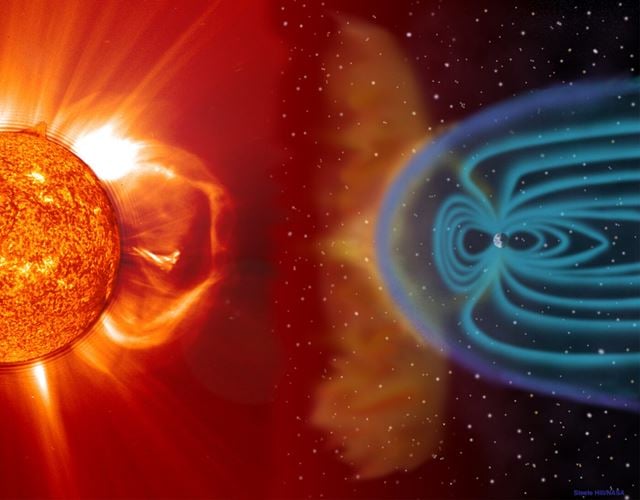
The sun ejects particles that create both beautiful auroras and dangerous space weather. It creates a geomagnetic effect that we don’t know enough about. Illustration: SOHO/LASCO/EIT/ESA /NASA
This is one of the questions that researchers are seeking answers to. To that end, they are studying how magnetic storms induce electrical currents in the ground.
Part of the answer may lie in events that have occurred in the Norwegian municipalities of Namsos and Sandnes. In both places, transformers were manually disconnected at the start of a strong solar storm, because monitoring measurements showed that they were about to be overloaded.
Vibrations that overturn alternating current
But what are these events?
“Geomagnetic storms are like nature’s bass frequencies. They’re invisible, but when they hit the right spot, they can cause a transformer to crackle – just like a speaker that is pushed too hard,” says Kristian Solheim Thinn, a research scientist at SINTEF Energy.

Kristian Solheim Thinn is a research scientist at SINTEF. His expertise is in electrical power supply – more specifically power cables, solar storms and electromagnetic fields. Here he shows the insides of a power cable. Photo: Hege Tunstad
A geomagnetic storm is nature’s way of cranking up the volume in the Earth’s magnetic field. And when nature turns up this volume, an electric field is formed in the Earth’s crust that can push unwanted and harmful currents into power lines and transformers – all without anyone having touched a switch.
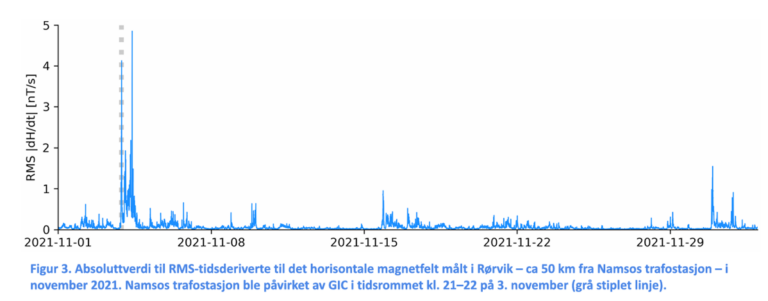
The blue graph shows how great the geomagnetic activity is, that is, the effect of the solar storm on the ground. The grey dotted line shows when the transformer station in Namsos was affected.
This is exactly what happened in Namsos municipality in 2024. A transformer received so much low-frequency “noise” from the ground that it simply gave up and was disconnected from the power grid. The vibration in the Namsos area was strong enough to be felt in the very heart of the power system.
“We can compare them, but transformer stations aren’t loudspeakers. And they react a little differently,” says Spencer Hatch. He is a researcher at the University of Bergen, and heads the project called Ny modell av induserte strømmer i norske trafostasjoner (New model of induced currents in Norwegian transformer stations).
“In other words, changes in the magnetic field, and not the absolute volume, are what have an impact,” he says.
“These changes become particularly strong when something large coming from the sun first hits the Earth’s magnetic field, and triggers the storm. This phase is called a ‘storm sudden commencement.’ ”
Not exactly off-the-shelf goods
“In the worst case, the storm could have resulted in major consequences for our transformer stations if we hadn’t caught this in advance,” says Thinn.

Spencer Hatch is a researcher at the University of Bergen, and is heading the project “New model of induced currents in Norwegian transformer stations.” Private photo.
The components that suffer from solar storms are not exactly off-the-shelf goods you can buy at the local convenience store, so society will save a lot of problems by staying ahead of the curve here.
“These geomagnetic storms aren’t anything we can stop. But we can still take some action to avoid transformer failures. Several of the measures are done manually and have to be coordinated, so it is absolutely necessary to have adequate warning time before the storm hits,” says the researcher.
“So now we are working on finding out exactly what happened in Namsos and elsewhere in the country. Then we can update the models we use to monitor the load our power grid is exposed to.”
Strange magnetic phenomena
Part of the wild card aspect is that the currents that spread in the ground are conducted in different ways depending on the ground conditions. The researchers will draw up a new map of how these geomagnetically induced currents can spread, and combine it with the overview of what our power system looks like today.
Once they have stitched all this information together into a new model, they will be able to both understand past events and simulate extreme events before they happen, such as a one-hundred-year solar storm. This model could probably be ready within a relatively short time period.
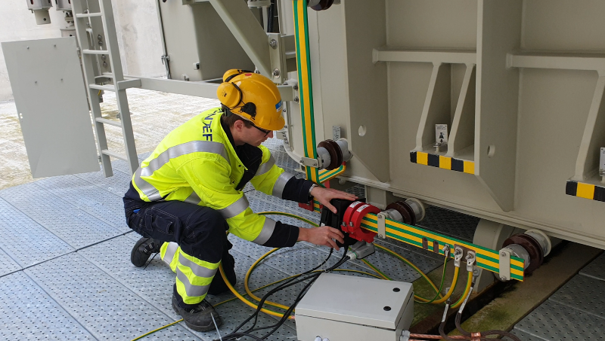
Installation of solar storm metres on a Norwegian transformer. These measure direct current in the neutral point of the transformers. In an ideal system, this current should be zero, but disturbances in the Earth’s magnetic field caused by solar storms still create strong direct currents that can damage transformers. Photo: SINTEF
Weather map for magnetic fields in the ground
To find out how solar storms create electric fields in the ground, researchers must first understand how the magnetic field over Norway behaves from second to second. They do this by using measurements from a whole chain of magnetometres, or solar storm metres, located around the Nordic region.
“Instead of observing one metre at a time, we use a method that allows the researchers to stitch together all the measurements into a kind of ‘weather map’ of the magnetic field variations, such as how the field shakes and undulates over the ground in real time,” says Hatch.
Once this map is in place, it is combined with information about the type of bedrock and soil layers that exist beneath us. Different types of rock conduct electricity differently, and this affects how strong electric fields are formed when the magnetic field fluctuates.
Finally, the researchers use this combination – the magnetic field map and knowledge of the ground – to calculate how strong the electric fields are along the power lines around a transformer station. And then they can make an assessment of how much storm force it can withstand.
A glass ball for weather predictions
The new geomagnetically induced current (GIC) modeling is not only intended to explain what is happening in and around Norwegian transformer stations here and now, but also aims to provide the possibility of looking a little further into the future.
Real-time measurements from Norwegian and Nordic magnetometers are fed into the model, and can thus be run continuously while the magnetic field above us shakes.
“That is what this model is intended to provide us with: a good decision-making basis for operating the power system safely and reliably. We don’t want to overload and thereby destroy the transformers. On the other hand, we also do not want to disconnect them until it is absolutely necessary, when the storms are at their worst and can lead to power outages over large areas,” Thinn says.
A concrete warning system aimed at the power grid could be in place in a short time, based on the research currently being conducted by UiB, SINTEF, Statnett and UiT.