After several weeks of empty store shelves and delays in food supplies, the long-awaited cargo ship arrived in Svalbard at the end of January. Technical problems and a lack of spare parts for the cargo ship carrying fresh food were the delaying factors.
The incident was a reminder of how vulnerable the supply lines to the archipelago actually are. Now attention is being focused on another critical resource: drinking water.
Vulnerable with only one source of drinking water
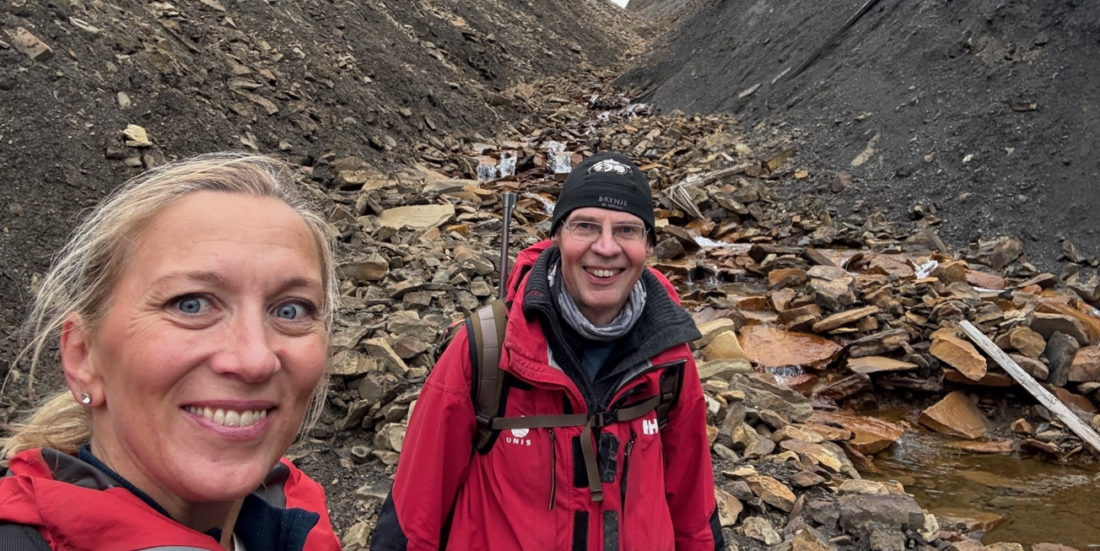
Isdammen, a 2.5 km long dammed fresh water pond, is Longyearbyen’s only source of drinking water, which makes for a precarious situation. In the fall of 2025, the local council commissioned a comprehensive condition analysis of the drinking water source.
The analysis is part of the local council’s work to ensure a safe and stable water supply to Longyearbyen in the face of both climate change and increased geopolitical tension in the Arctic.
“We will help to establish a solid knowledge base for how water quality, water quantity and the dam construction itself could evolve in the coming years,” says research manager Hanne Kvitsand at SINTEF.
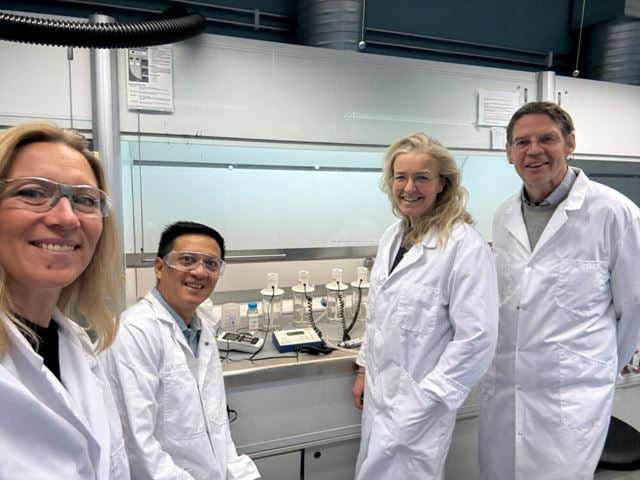
Water quality under the scientific microscope: Hanne Kvitsand and Gema Sakti Raspati (SINTEF), Frøydis Sjøvold from the Longyearbyen local council and Gijsbert Breedveld (UNIS) in the lab. Photo: UNIS
SINTEF is heading the work, which is being carried out in close collaboration with researchers from the University Centre in Svalbard (UNIS) and the University of Bergen (UiB). The study report will be ready during the second quarter of 2027.
“The water project in Longyearbyen has developed from a limited purchase of desalination plants to becoming a far more comprehensive project. Today it includes both a reserve water solution, firefighting water capacity, pipeline systems and securing our main water source,” says local council chair Terje Aunevik (V – Norwegian Liberal Party).
In many areas, what is happening here could be a foretaste of what’s to come for other communities.
“In the midst of this work, we have also seen extreme fluctuations in manganese values, which has meant that we’re now distributing drinking water outside of the ordinary water supply. This underlines the seriousness of the situation,” says Aunevik.
Why is the water changing?
There are many unanswered questions about what is actually happening in and around Isdammen. The manganese content in the untreated water has increased in recent years, without the cause being clear.
“We need to find out where the water in Isdammen actually comes from. To what extent is it surface water, groundwater and/or inflow from old mine shafts,” Kvitsand says.
In particular, the researchers’ concern is related to the permafrost that is gradually thawing. If the ground around the pond thaws, the water in the subsoil could create new flow pathways.
“We don’t know for sure how the water channels and water quality will change as the permafrost thaws. We need to investigate this thoroughly,” she says.
Fieldwork, tests and future scenarios
The research team will conduct literature studies and extensive field investigations. These will include analyses of water quality, the use of stable isotopes to identify water sources, eventually permafrost and hydrology mapping in the catchment area, as well as investigations of the ground conditions under the dam construction itself.
Climate change makes it crucial to know what we might expect in the coming decades. Isdammen is the lifeblood of Longyearbyen’s water supply.
“The first goal of the project is to characterize the current untreated water quality, calculate the water balance and understand the inflow, and assess the technical stability of the dam. Once the knowledge base is in place, we can develop models for future scenarios based on different climate projections,” says Kvitsand.
Important work for a safe Svalbard
Finally, the researchers will provide recommendations for what measures are needed to ensure the water supply according to the requirements of the Norwegian drinking water regulations – and to Longyearbyen’s own goals for preparedness and safety.
This investigation and analysis is about technology and preparedness – but just as much about understanding nature’s slow but powerful changes in the Arctic.
“Climate change makes it crucial to know what we can expect in the coming decades. The ice dam is the lifeblood of Longyearbyen’s water supply, and we have to ensure that it remains functional into the future,” says Kvitsand.
As is well known, Svalbard is the place on the planet that is currently experiencing the fastest temperature changes.
“In many areas, what is happening here could be a foretaste of what is to come for other communities. We’re concerned with thorough approaches and fact-based decision making. The research team’s contributions are absolutely crucial for us,” says Aunevik, chair of the Longyearbyen local council.
Facts about the project:
Name: Water supply to Longyearbyen – characterization and condition analysis of Isdammen reserve freshwater supply
Research partners: SINTEF, the University Centre in Svalbard (UNIS) and the University of Bergen (UiB)
Duration: 2025-2027
Funding: Longyearbyen Local Council