A battery is more than just a battery. Where and how it is produced is critical for environmental impact, costs, and quality.
– Batteries rely on raw materials that are often scarce and currently largely extracted and processed in politically unstable and unpredictable regions, says SINTEF researcher and project manager Nils Peter Wagner.
Until recently, most battery‑cell production has taken place in Asia, accounting for more than 95 percent of global lithium‑ion cell manufacturing. This is why efforts are now underway to make Europe more self-sufficient in battery production.
After four years of European collaborative research, the IntelLiGent project team is now presenting promising results.
– We have examined every part of the battery cell, down to the smallest detail, to identify the optimal material composition, says Nils Peter Wagner, who has led the IntelLiGent project.
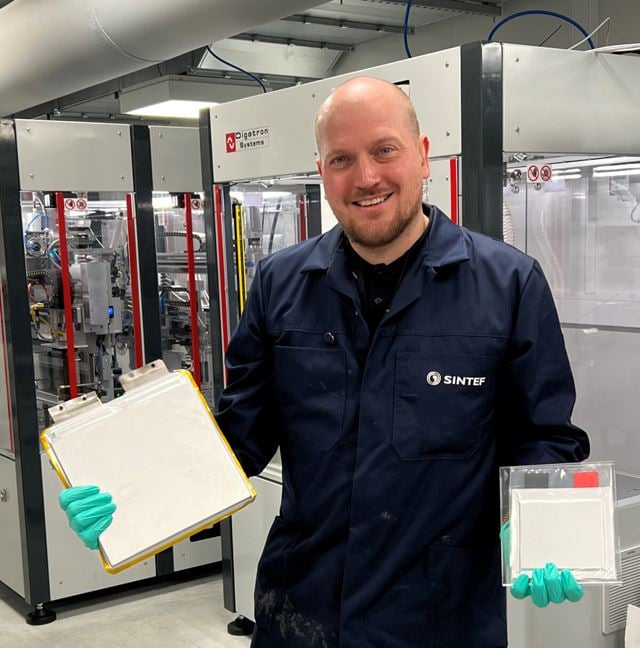
At the SINTEF Battery lab, SINTEF researchers study all stages of battery cell production. Here is project manager Nils Peter Wagner holding two pouch cell batteries at the lab. Thor Nielsen/SINTEF
Putting consumers in the driver’s seat
The goal of the EU-funded project has been to develop more sustainable, efficient, and intelligent electric (EV) batteries.
– We have achieved this by using the most environmentally friendly materials possible. At the same time, we have given the batteries high power and the ability to store large amounts of energy in a compact format.
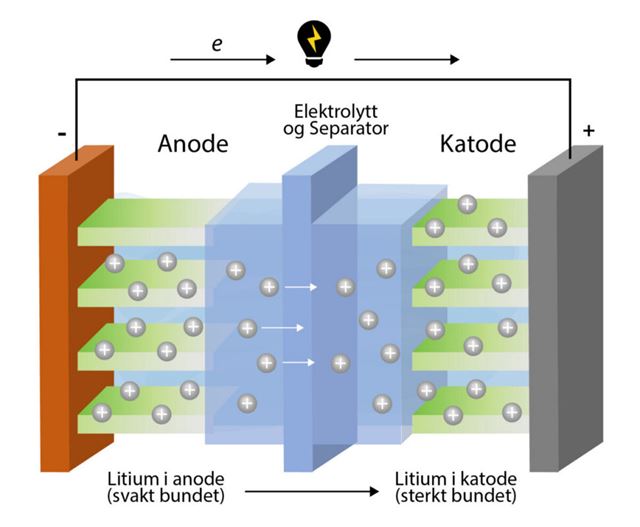
This is how a battery works:
A battery consists of two electrodes, namely a cathode and an anode, separated by a porous separator, and contains an electrolyte that allows ions to move between them. When the battery charges and discharges, ions shuttle back and forth between the electrodes, while electrons flow through an external circuit. The efficiency of this process affects driving range, charging time, and battery lifetime – and depends heavily on the materials and internal design. Binders maintain the electrode structure holding the active electrode materials (LMNO and silicon graphite) in place, while the separator keeps the electrodes physically apart to prevent short circuits. Illustration by SINTEF.
This matters, because electric vehicles must be an attractive choice for consumers if EV battery production is to truly take off in Europe. They must offer good driving range, short charging times, long battery lifetime, environmental benefits, and an affordable price.
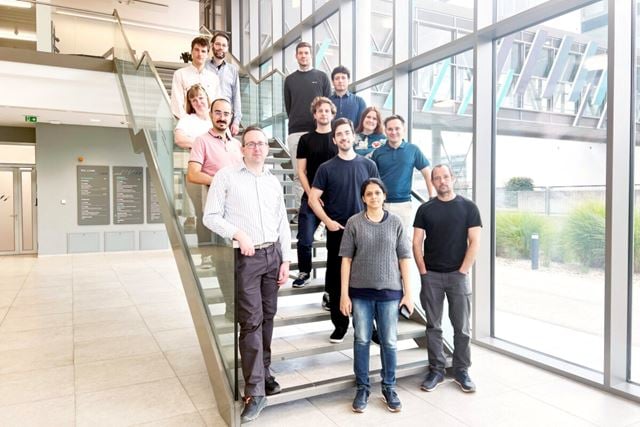
The IntelLiGent project crew has brought together world-leading battery researchers and industry partners from across the entire battery value chain. Here is the team gathered at the Austrian Institute of Technology (AIT) in Vienna. Ruben-Simon Kühnel (Empa), Noel Hallemans (University of Oxford), Ingeborg Kaus (SINTEF), Sergi Obrador Rey (IREC), Peter Molesworth (SINTEF). From top right: Mirco Ruttert (E‑Lyte), Killian Stokes-Rodriguez (SINTEF), Lukas Neidhart (AIT), Benedicte Eikeland Nilssen (Vianode), Graham Kimbell (Empa), Piotr Jankowski (Topsoe), Sridevi Krishnamurthi (SINTEF), Lluis Trilla (IREC). Photo: SINTEF
Using less critical raw materials
One of the researchers’ “secrets” lies in reducing the use of critical raw materials. The project has resulted in a new generation of the material lithium‑nickel‑manganese oxide (LNMO), used in the battery’s cathode. The material is cobalt‑free and contains less lithium and nickel than those used in today’s batteries, while still delivering high energy density and high voltage without compromising performance.
A new Norwegian composite material
For the battery’s anode, researchers have created a composite consisting of both silicon and graphite. Silicon can store far more lithium ions, providing higher energy than today’s standard anodes, while graphite adds strength and stability. The composite results in batteries with higher capacity and longer lifetimes. The material is produced by Norway-based Vianode, which can manufacture graphite with 90% lower emissions than other manufacturers, as well as reduced resource consumption.
Longer battery lifetime
The quality of the electrodes is crucial for the performance, lifespan, and safety of the finished battery cells. The IntelLiGent research team has optimized the structure and electrodes to increase energy density and charging capability, while ensuring that heat does not build up inside the battery. In addition to working on improving the active materials, they have also developed an electrolyte that protects both the anode and the cathode even at high voltages, improving stability and extending battery life.
Developed active, self-mitigating binders
To maintain the integrity of the electrode structure, the research team has developed new binders. Binders hold the electrodes together throughout the battery’s lifetime, and under demanding chemical conditions.
Traditionally, binders are important but passive components in batteries. This means they have no additional function. In IntelLiGent, however, the binders have been made active by selecting materials that also provides multiple functions. The binders in this battery offer active protection and prevent unwanted side reactions:
– Binders are often based on fluorinated polymers such as PVDF, which require toxic and environmentally harmful solvents. In this project, we tested different polymers and ultimately succeeded in replacing PVDF with a water-soluble binder that also offers additional beneficial functionalities, explains Wagner, adding:
– Our binders can trap the metal ions manganese and nickel when they are released from the cathode, preventing them from reaching the anode, where they can cause lithium plating and reduce the battery’s lifetime, says Wagner.
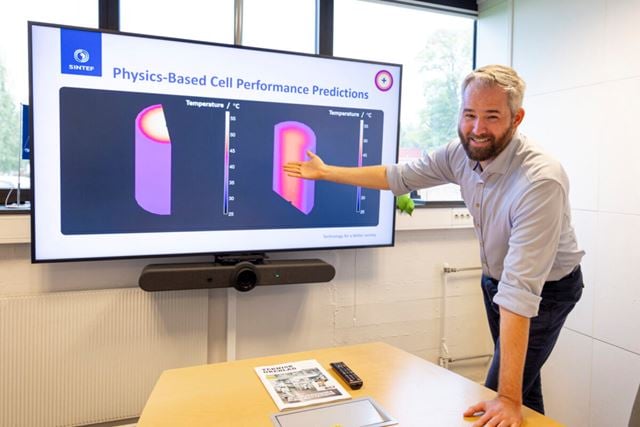
IntelLiGent’s new batteries have been thoroughly tested, improved, and further developed using advanced digital tools, which will also play an important role in future battery research and innovation. Here, senior researcher Simon Clark demonstrates a simulation of the temperature inside a battery cell during discharge – an important aspect for ensuring safety and preventing degradation. Photo: Thor Nielsen/SINTEF
On the road to commercialization
One of the biggest challenges in scaling up battery‑cell production is manufacturing electrodes at an industrial scale. At the SINTEF Battery Lab in Trondheim, Norway, the project has demonstrated that electrode production can be scaled from lab level to a more industrial format.
“At the battery lab, we have succeeded in producing water-based electrode rolls with high density and uniform quality at scales of up to 100 metres. This represents a milestone for both European and Norwegian battery research and an important step towards local industrial battery cell production”, says Nils Peter Wagner.
This is one of the first European examples of scaling up water-based LNMO cathodes with high material loading and energy density for electric vehicles. It is also one of the first successful efforts to scale up electrode production in Norway.
The project has also produced more than 60 battery cells of 15 Ah (ampere-hours). In addition, MILLOR BATTERY in Spain has developed and manufactured a battery module based on the project’s battery cells, demonstrating that the new battery chemistry can be implemented and scaled for future battery packs.
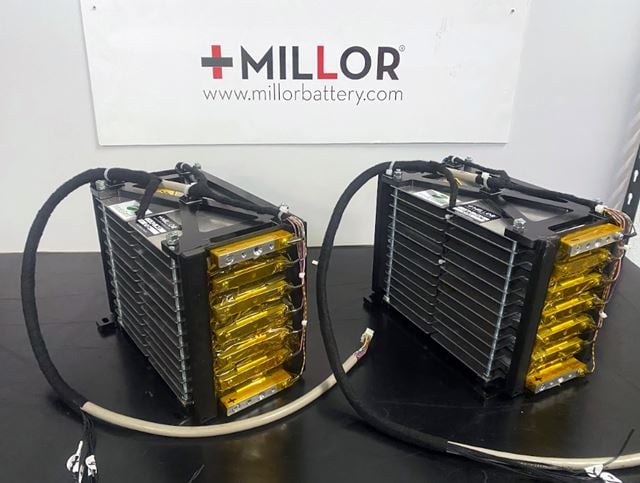
An important project milestone was reached at MILLOR BATTERY, where the company has developed and manufactured a battery module based on the IntelLiGent cells produced at SINTEF’s battery laboratory. Photo: MILLOR BATTERY
Facts about the IntelLiGent EU project:
The Horizon Europe project IntelLiGent set out to develop safe, sustainable generation‑3b Li‑ion batteries with long lifetime, based on high‑voltage cathodes and high‑capacity silicon‑graphite anodes.
IntelLiGent’s new batteries have been thoroughly tested, improved, and refined using advanced, innovative programming and modelling tools, which will play a key role in further battery research and innovation.
The IntelLiGent Gen 3 battery cells have also been benchmarked against today’s solutions in terms of environmental impact, economics, and social sustainability, demonstrating their strong potential as a competitive and sustainable next-generation battery technology.
The project began in 2022 and concludes in 2026, with a total budget of €8 million.
The project is funded by the EU, in addition to funding from the State Secretariat for Education, Research and Innovation (SERI) in Switzerland and the UK Research and Innovation fund (UKRI).
The project is coordinated by SINTEF Industry, with partners Vianode, University of Oxford, Austrian Institute of Technology (AIT), MILLOR BATTERY, Topsoe, E‑Lyte, Empa, and IREC.
For more information, visit heuintelligent.eu.
References:
Physics-Based Battery Model Parametrisation from Impedance Data – IOPscience
Realization of Aqueous Processed LiNi0.5Mn1.5O4 through the pH Optimization of Polyacrylate Binders