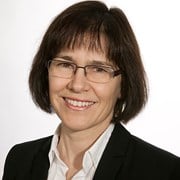
– We can do more. We need more support for research cooperation with the Global South, Mølnvik said.
CCS must move to gigatonne scale, as moderator Jarad Daniels, CEO of the Global CCS Institute, underlined – and that will not happen in the Nordics alone.
The session, “The Nordics as a launch pad for scaling carbon management”, was hosted by the Global CCS Institute and opened by Mari Sundli Tveit, CEO of the Research Council of Norway and President of Science Europe.
Everything works at Brevik
Mølnvik’s confidence rests on results at home. The capture technology now running at full scale at Heidelberg Materials’ cement plant in Brevik was developed by researchers at NTNU and SINTEF with support from the Research Council of Norway, and the solution for the cement plant was found when Heidelberg Materials and SINTEF worked together in an EU project.
There is very little media coverage of things not working at Brevik, simply because everything works, she said. That is the result of all the knowledge built up through many years of research. We should be proud of that. To find the answers, we have to do it together.
Winston Beck, Senior Vice President at Heidelberg Materials, said the company is “over the moon” with Brevik. A 100-year-old plant now runs brand-new CCS technology, and the company can offer the world’s first cement with captured and stored CO₂.
Norwegian government support was decisive, he said, since CCS is both capex- and opex-intensive. What industry needs next is incentives that create a business case and a market for decarbonised products.
Thirty years of long-term commitment
CCS as a climate technology began in Norway with Sleipner in 1996. Since then, Norway has built a chain of research and demonstration: Gassnova and the CLIMIT programme in 2005, Technology Centre Mongstad in 2012, and in June 2025 the official opening of Longship, with capture at Brevik and permanent storage under the North Sea through Northern Lights.
– Without long-term research, Longship would not have been possible, said Rune Volla of the Research Council of Norway.
His formula: long-term commitment, industry-driven research, and piloting and shared infrastructure. The national research effort is today led by FME gigaCCS.
Ane Gjengedal of the Norwegian Ministry of Climate and Environment added that Norway has backed CCS regardless of government, building on oil and gas expertise and strong research communities from the start. Norway now receives CO₂ from three European countries.
The Nordic experience travels
Isabela Morbach, co-founder of CCS Brasil, said Brazil has a strong offshore sector like Norway and large cement, steel, oil and gas and bio industries, giving the country huge CCS potential.
Brazil can learn from Norway, she said, and support from the Norwegian Embassy and Innovation Norway was important in convincing the Brazilian government to back CCS in the first place. gigaCCS already cooperates with Petrobras in Brazil, Mølnvik noted, and there is a lot to gain from that.
Not done researching
Mølnvik warned that the job is not finished.
– We know much more now about CO₂ flows, based on excellent research. But that takes time and money.
The next challenge for gigaCCS is handling non-condensable gases in the CO₂ stream, which affect transport and storage.
Asked for her final word, she kept it short:
“Research works.”
Tim Dixon of IEAGHG closed the session on the same note: strong government support, strong industry and strong research communities are what it takes – wherever in the world CCS is to scale.