For some people, the overhead lines are a blight on the landscape; for others, they are a source of pride representing civilization and prosperity. These power lines that we have built up over time have provided society with light, heat, and the foundation for industry. Now, however, parts of this grid are beginning to show their age.
As some components reach the end of their service life, the need for renewal becomes urgent. So, how can we effectively allocate scarce resources to an increasing number of users when the power grid is rapidly reaching the end of its operational lifespan?
To address this urgency, Norway’s power industry and researchers have collaborated to develop a new system for renewal planning. The goal is to automate the initial screening process, making the task of planning the maintenance and replacement of grid components more manageable.
“We don’t have the luxury of basing renewals solely on age,” explains Øyvind Slethei, project manager at REN, a Norwegian company specializing in solutions and standards for the power grid.
Risk-based initial screening
The model provides grid operators with a ranked list identifying which lines and utility poles carry the highest risk of failure. The list helps them determine the highest maintenance priorities, using an entirely new approach. You may have seen it in movies: the clever characters who realize that by piecing together seemingly unrelated bits of information, they can arrive at the solution. A background sound—perhaps a church bell and a passing train—reveals a specific location, as that particular sound combination could only exist in one place.
This same line of reasoning can be applied to pinpoint the exact location of utility poles that need maintenance. Incredible? Indeed.
Mission possible
Slethei is the project manager for RIFOK, a project focused on risk-based renewal planning for power lines in Norway. He explains that the industry is facing pressure from several directions. It is not just the power grid itself that is nearing retirement age; the same is true for many of the professionals who work on planning within the sector. Consequently, a smarter approach is required.
“We need to identify the projects that offer the best value for money, as resources are extremely limited,” he says.
We’re talking about hundreds of thousands of wooden utility poles and overhead lines that are long enough to wrap around the Earth one and a half times—at the equator. So, where do we begin?
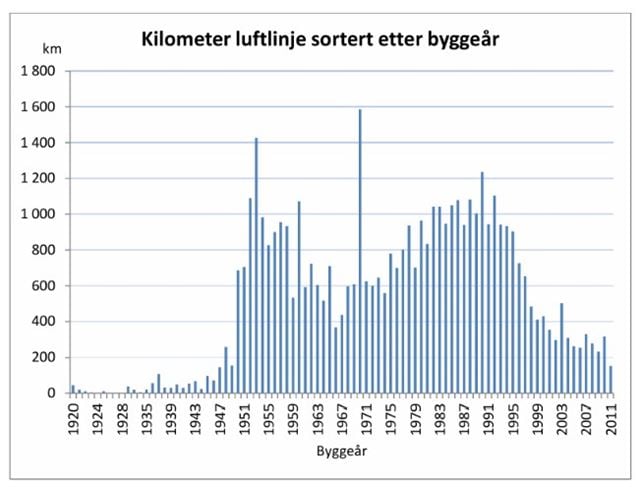
Norway builds many metres of power lines every year. This chart illustrates the scale and timing of that construction. Much of this infrastructure is nearing the end of its service life. Furthermore, 13,000 km of overhead lines do not have a recorded construction year. Source: NVE
Synthesizing probability maps
Naturally, maps showing the locations of these poles already exist. When this information is combined with everything we know about the utility poles, we can begin to identify which poles should be prioritized for closer inspection. This includes data on the year of construction and technical specifications, weather maps that indicate potential wear and tear, and land-use maps that provide information about the soil conditions in which the poles are situated.
All of this can then be integrated into advanced calculations regarding how, for instance, a wooden pole degrades due to rot.
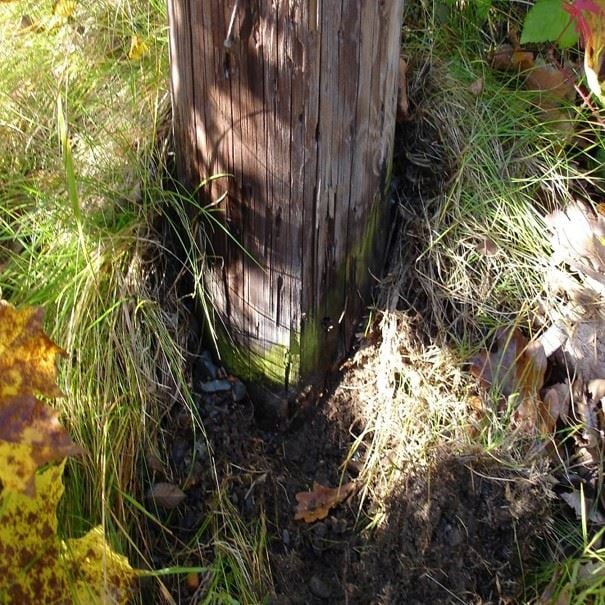
This pole is affected by rot. But should it be removed immediately, or can it wait? Photo: SINTEF
However, simply combining existing information is not enough, as old maps do not always accurately reflect the actual terrain.
The devil is in the Norwegian details
Wooden poles are the main supports for the overhead power network—and wood rots. But how quickly? The researchers examined various existing models, including some from Australia. Yet, when compared against tens of thousands of rot-inspection records from Norway, it became clear that these existing models were inadequate for the project’s needs. A valuable outcome of this project is a new model for rot progression, developed using a vast amount of data.
“Existing models for calculating the rate of rot in wood are largely based on test data from wooden stakes placed in a controlled test field. But a utility pole doesn’t just stand in an open field; it might be located in a bog or in a residential area surrounded by asphalt,” says Tom Ivar Pedersen, a research scientist at SINTEF.
The researchers adjusted the model to ensure it is well-suited for utility poles under Norwegian conditions. It can now use climate, land type, preservative treatment, age, and diameter to estimate the likely extent of a utility pole’s deterioration, even before anyone has inspected it.
Drones not yet sophisticated enough to take over
Then the question arose: can we leave inspections to drones?

Research scientist Tom Ivar Pedersen. Photo: SINTEF
Several grid operators have tested the analysis of drone-captured imagery, and Pedersen has interviewed several of them for the project.
“Image recognition can detect when something is missing, such as a top cap. However, determining whether a crack in a pole is critical remains a challenge. Many people find drone technology exciting, but a human still needs to review all the images,” he says.
Consequently, drone technology does not yet offer many gains. Nevertheless, Pedersen believes that the meticulous labelling of images over many years will provide a better foundation for training image-recognition models. Other types of models will also be part of the picture.
An important new tool for maintenance planning
Once the data has undergone quality assurance, the next step is to integrate the data. The question is how to link all the information to create the most accurate picture possible regarding the failure probability. In this regard, researchers are close to achieving a model that can be used to prioritize maintenance needs. The model also accounts for the potential impact on people should an incident occur, and not just the financial consequences. After all, we certainly don’t want a utility pole next to a kindergarten to collapse.
“If a power line in a built-up area is in equally poor condition as a pole in the forest, the line in the built-up area will have a higher priority on the list. However, if the line in the forest is in significantly worse condition, it might still take priority,” explains Pedersen.
Power outages are costly—even for grid operators
Grid operators are already legally required to regularly inspect poles and overhead lines. This new method is not a replacement for such inspections. Rather, it provides an additional basis for decision-making, helping to determine where and when replacing or maintaining various components is both necessary and cost-effective.
“The data collection itself isn’t the hardest part. The real challenge lies in following up on identified anomalies and synthesizing the data so that it is effective for making sound decisions,” says Slethei of REN.
A power outage affects more people than just those left sitting in the dark. Utility companies face a reduction in revenue equivalent to the cost the outage imposes on their customers whenever a power outage occurs. In 2020, this amounted to nearly NOK one billion nationwide, with companies participating in the RIFOK project accounting for 42 percent of that total. Consequently, it makes sense to identify utility poles at risk of failure before it is too late.
The project is nearing its conclusion. The Norwegian industry’s guideline standard format for best practices, the “RENblad,” will incorporate the new method. The intention is for all grid companies to adopt this new approach to renewal planning as soon as it becomes available through the industry’s dedicated portal for guidelines and tools.
Project Facts:
- Project Name: RIFOK (Risk-based renewal planning for power lines)
- Objective: To leverage existing data to predict which overhead lines are most likely to fail, and why. This enables grid companies to renew the right lines at the right time, reduce the number of faults, spend less time on physical inspections, and extend the service life of assets that remain in good condition.
- Project Type: Industrial innovation project, funded through the Research Council of Norway’s ENERGIX programme.
- Project Owner: REN, an organization that develops common standards and best practices for the power grid industry. The project manager is Øyvind Slethei.
- Research Partner: SINTEF Energy, with Tom Ivar Pedersen serving as project manager.
- Grid Companies: Elvia, Glitre Nett, Lede, and Nettalliansen (which represents approximately 25 small and medium-sized grid companies). These partners contribute funding, data, and technical expertise.
- Reference party: NVE
- Period: 2022–2026
- Budget: 8.7 million NOK
- Background: Builds upon the research project REPLAN (2014–2017), which developed a method for calculating the costs associated with renewal—or the decision not to renew.