The waves and the boat roll in and out of sync. The creels need to go overboard. Suddenly your feet slip out from under you and before you know it, you’re in the icy water, watching the boat drift away.
But all hope is not lost: your wristband detects the fall, stops the boat, and triggers alerts, flashing lights, and sound signals. You therefore know that rescue crews and nearby vessels have been notified, and help is on the way.
This is the scenario envisioned by the entrepreneurs behind the solution.
“Our goal is to save lives,” say father and son Audun and Ronny Bakke, founders of the west coast‑based company Dimeq. Both have worked at sea and have a personal commitment to safety.
A ‘vision zero’ for safety at sea requires measures for professional fishers:
Professional fishers are the occupational group most exposed to accidents in Norway. Shipwrecks and man‑overboard incidents make up the majority of fatal accidents in the coastal fishing fleet. These accidents were the main cause of 149 deaths among professional fishers between 2000 and 2022 (Holmen et al., 2023).
In 2025, the Norwegian Maritime Authority published the National Action Plan for Maritime Safety, proposing a range of measures to achieve a ‘vision zero’ for serious injuries and fatalities in Norwegian waters. Among these measures is a requirement for emergency stop devices when individuals work alone on commercial vessels.
An advanced solution
The ambition now is to bring the smart wristband for fishers working alone to market. But, as with all seemingly “simple” and “obvious” solutions, a great deal of work, testing, and fine‑tuning lies behind it.
The collaboration between maritime safety‑system supplier Dimeq AS and SINTEF in Norway, has been central.

Researcher Trine Thorvaldsen at SINTEF Ocean. Photo: SINTEF
“A few years ago, SINTEF, in cooperation with fishers, the Norwegian Maritime Authority and others, developed a set of requirements for engine emergency stops and alerts to emergency services and other vessels, specifically adapted for fishers working alone,” explains Trine Thorvaldsen, Senior researcher at SINTEF.
“The usefulness of developing this solution is also high for other countries and sectors, such as the aquaculture industry.
The FHF – Norwegian Seafood Research Fund wanted to support the development of the solution, and the assignment went to Dimeq and SINTEF.
The result is updated requirement specifications for an emergency stop and alert system, knowledge of relevant approval and certification schemes, and a system developed and tested under realistic conditions by real users.
Automatic emergency stop and alert system
In recent years, Dimeq has further developed a system with a control unit installed in the wheelhouse. This is then connected to personal wristband units.
When a person falls overboard, the system stops propulsion, triggers local alerts on the boat, and sends emergency and alert system signals via VHF DSC to the Norwegian coastal radio (Telenor Coastal Radio) and nearby vessels.
D-oris, next-generation safety system for the fishing industry
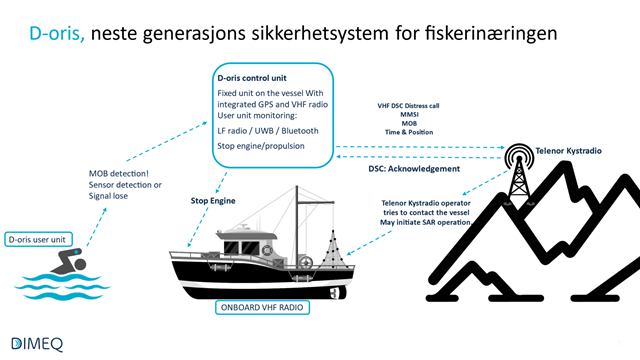
D-oris works by automatically triggering the wristband in the case of a fall overboard. It sends a signal to the control unit in the wheelhouse, which cuts the engine and sends an emergency alert via the coastal radio. Illustration: Dimeq AS
Tests carried out by SINTEF on board a fishing vessel in winter 2025 show that the system largely meets the project’s predefined requirements for an automatic emergency stop and alert system.
Experience from the tests and from users is now being used to reduce false alarms and simplify the user interface. What remains is to obtain the final approvals.
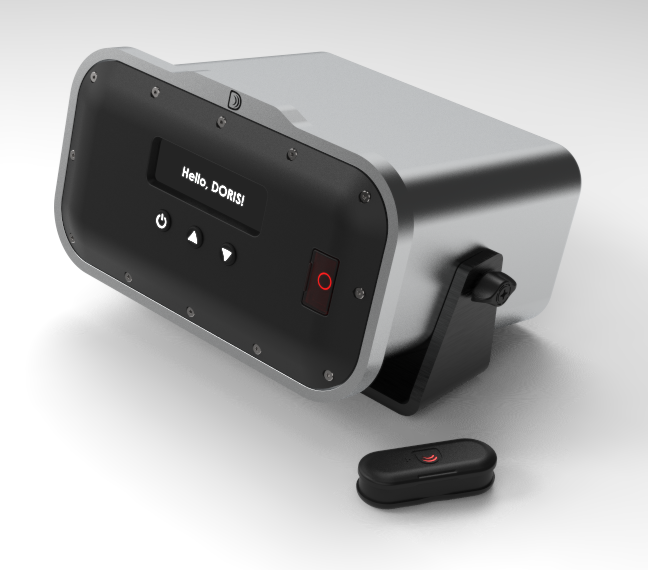
This is what the equipment looks like. Photo courtesy of Dimeq AS
“There is great interest in the solution, and we are continuing work on completion and approvals so that we can contribute to safer working conditions for thousands of fishers along our coast,” says Audun Bakke.
High value for search and rescue
SINTEF has worked on maritime safety for several decades and believes that technology is one of several important measures.
“The usefulness of developing this solution is also high for other countries and sectors, such as the aquaculture industry. The solution will also be valuable for efficient search‑and‑rescue operations,” adds Trine Thorvaldsen.
The project Development, testing and approval of a system for the emergency stop and alert system in the coastal fishing fleet was funded by FHF – Norwegian Seafood Research Fund.