In 2021, researchers at Oslo University Hospital discovered that by switching off a specific gene in the roundworm C. elegans, they could protect a particular type of nerve cell from age-related degeneration. These are the same types of nerve cells that affect patients with Parkinson’s disease.
This discovery has prompted researchers to investigate further. Artem Komissarov, a research scientist for SINTEF’s Biotechnology and Nanomedicine department, explains:

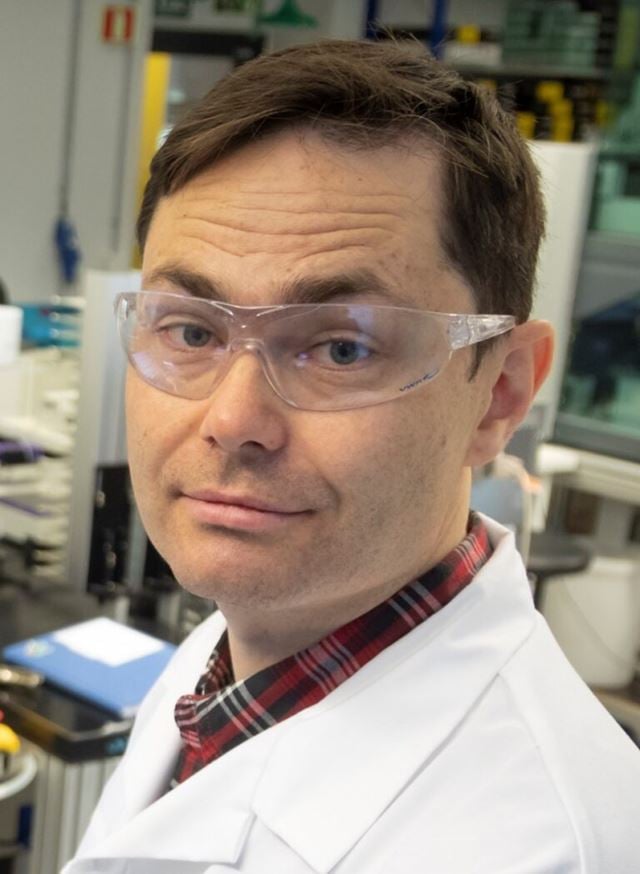
Researcher Artem Komissarov works in the field of biotechnology and nanomedicine. He found that reducing the expression of this gene – thereby lowering the production of the protein it encodes – has a beneficial effect on cell survival in our experimental models of Parkinson’s disease. Photo: SINTEF
Much like a precious reference work, our genes contain precise codes for every single protein our body produces. If damage occurs to our genetic material – our DNA – enzymes step in to repair the error.
“This process requires a series of enzymes, each performing a specific task. A bit like the mechanics during a Formula 1 pit stop,” says Komissarov.
Mitigating oxidative stress
The enzyme that this particular roundworm gene produces plays a crucial role in repairing damaged DNA. However, this error-correction process does not always work to our advantage.
Experiments with human cells show that when this enzyme is absent, the cells’ powerhouses – the mitochondria – become more resistant to oxidative stress, which is closely linked to Parkinson’s disease.
Researchers at SINTEF are currently working to identify methods to reduce the production of this enzyme. They have developed and tested a synthetic DNA molecule on human cells (HEK293). These experiments were not conducted on nerve cells, but rather on a cell line frequently used in laboratory research.
Utilizing mRNA “vaccine technology”
“We exposed the cells to a substance (MPP+) often used in experimental Parkinson’s models to impair mitochondrial function and induce oxidative stress. When the cells were exposed to this substance alone, approximately 40 percent of them died.”
However, when the researchers also introduced an “ASO candidate,” all the cells in the experiment survived.
ASO stands for “antisense oligonucleotide,” a segment of DNA specifically designed to suppress the production of certain proteins. But the process was not entirely straightforward.
To avoid interfering with the genes themselves, the technology targets the messenger – mRNA – that shuttles information between the DNA in the cell nucleus and the protein-manufacturing machinery elsewhere in the cell.
Komissarov explains: “Think of genes like a book in a library. Instead of taking out the entire book, you make a copy of the specific ‘recipe’ that you’re interested in. This copy is RNA. In other words, the DNA remains inside the cell nucleus, while the RNA carries the recipe out to create the protein.”
Facts about ASOs:
Antisense oligonucleotides, abbreviated ASOs, are short, synthetic, DNA-like molecules designed to interact with RNA within cells. They can either trigger the breakdown of RNA, thereby reducing the production of a specific protein, or alter how RNA is processed, enabling cells to produce a more functional protein. ASO technology is already being used in medications for certain hereditary diseases, including spinal muscular atrophy.
Doing the opposite of the COVID vaccine
“With an mRNA vaccine, you introduce a recipe that allows cells to produce a protein that mimics the virus. In our case, we destroy the recipe to reduce protein production,” says Komissarov.
Unlike knocking out a gene entirely, ASO technology makes it possible to regulate the amount of protein produced.
“Instead of switching a gene on or off like a light switch, an ASO acts more like a dimmer. We hope to determine how much we can reduce the production of the enzyme to achieve the best possible therapeutic effect, without causing unnecessary side effects,” says Komissarov.
Torkild Visnes, a senior researcher at SINTEF, says the goal is to help people stay healthy and minimize the need for medical care for longer. Photo: Thor Nielsen
The results indicate that the ASO candidate can protect cells against oxidative stress in a simple experimental model.
“This is particularly important for mitochondria in the brain, as this organ consumes a large amount of oxygen,” says Komissarov’s colleague, SINTEF senior researcher Torkild Visnes.
Screened multiple candidates
To identify the right ASO sequence, SINTEF utilized its own laboratory platform, which enables the parallel testing of thousands of drugs, chemical compounds, and cell samples. Using robots capable of handling extremely small samples, the researchers can assess both the efficacy of the substances and whether they are toxic to the cells.
The researchers have now screened several ASO candidates to see how effectively they were able to suppress the specific gene.
“We found several promising candidates where gene expression was reduced by around 70 percent. We also examined toxicity at various concentrations. Even at very high concentrations, 93 percent of the cells survived, which indicates a generally low level of toxicity,” says Komissarov.
Could also work for other diseases
Komissarov emphasizes that a great deal of research remains to be done before they will be able to announce a treatment for Parkinson’s disease.
“We’re at a very early stage. And we have to remember that the great majority of all new drugs being tested fail. But we want to try,” he says.
The hope is that it will be possible in the long term to develop a medicine that can slow the progression of the disease.
“As the population ages, Parkinson’s disease places an ever-increasing burden on patients, their families, and the healthcare system. Our goal is to help people remain healthy and minimize the need for healthcare services for longer,” says Visnes.
The researchers at SINTEF are also working on other neurodegenerative diseases. Work is currently underway on a patent based on this technology.