The COVID vaccine is perhaps the first thing many people think of when they hear about drugs based on mRNA. Small packages of genetic material are sent into the body, where they make our cells produce useful proteins in the fight against the virus.
But the list of diseases that can potentially be treated with mRNA-based drugs is much more extensive than just vaccines. mRNA is expected to be used in treating disorders including cardiovascular diseases, rare hereditary diseases and autoimmune diseases – and not least, cancer.
“Almost all diseases we know are caused by some protein or another. Either there’s too much protein, or too little, or the protein has a defect. Proteins are encoded by mRNA. The potential for mRNA drugs is therefore enormous. They will be a very important tool,” says researcher Sjoerd Hak, from SINTEF’s Department of Biotechnology and Nanomedicine.

“Preclinical testing is enormously important, as is creating models that are more similar to humans,” says researcher Sjoerd Hak (pictured). He is surprised that more research is not being done on the use of normal human blood for such drug testing. Photo: SINTEF
Researchers at SINTEF have tried out a new method that will make it easier to develop new forms of the mRNA drug.
“Ninety percent of all drugs that are tested in clinical trials on humans are not approved. Therefore, it is important to be able to identify the best drugs and weed out the bad candidates before you get to that point,” says Hak.
Trial and error
A major reason why so many drugs fail during testing is the big difference between humans and the animals used in preclinical testing. What may look promising when tested in mice may have zero effect or even cause serious side effects when injected into the bloodstream of a patient.
Almost all diseases we know are caused by some protein or another. Either there’s too much protein, or too little, or the protein has a defect. Proteins are encoded by mRNA. The potential for mRNA drugs is therefore enormous. They will be a very important tool.
One of the major challenges in the development of mRNA-based drugs is the way the mRNA is packaged. mRNA is unstable, and in order to be used as a drug, the small piece of genetic material must be packaged in small fat particles. In technical terms, these particles are called lipid nanoparticles or simply LNPs.
Ninety percent of all drugs that are tested in clinical trials on humans are not approved. Therefore, it is important to be able to identify the best drugs and weed out the bad candidates before you get to that point.
When the tiny particles are injected into the blood, the outer fatty layer will bind to proteins in the blood plasma, and the nanoparticle will encounter immune cells circulating in the blood. What happens next – whether the immune cell “eats” the particle and what happens inside the immune cell afterwards – will determine the effect of the medicine.

Researcher Jérémie Parot is also participating in the project. Here he demonstrates one of the machines used to test lipid nanoparticles with mRNA in blood samples from humans. Photo: Silje Grytli Tveten/SINTEF
“LNPs can be made in a thousand different ways. How they are put together is crucial for how the mRNA will enter the cells and function as medicine. That is why you have to create and test a lot of different variants,” says Hak.
Human blood as a test environment
Hak and his colleagues have now looked at how to test the drugs in human blood from donors, instead of injecting the drugs into the body.
By using human whole blood, that is, fresh blood that contains all of the blood cells and plasma, the researchers have tested different mRNA-LNP particles and how they have been taken up by immune cells in the blood. They have also looked at which signal substances the cells have produced. Signal substances control the immune response and are an important part of how the drugs work.
The results show that this method enables researchers to see which variants of mRNA-LNP had the greatest uptake in the immune cells, and which ones triggered strong or weak activation of the immune system.
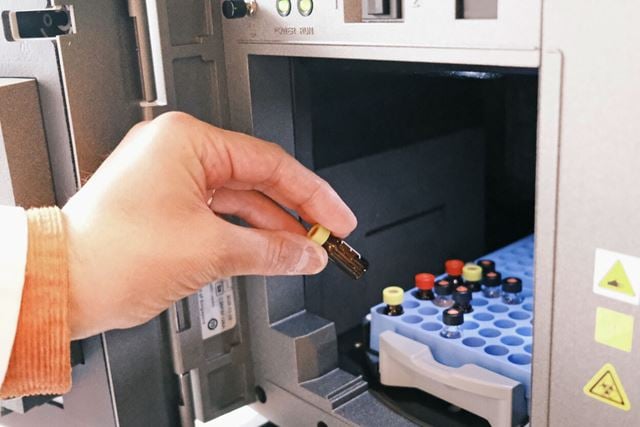
New medicine based on the genetic material mRNA is tested in human blood at SINTEF Industry. Photo: Silje Grytli Tveten
“The results are showing that testing with human whole blood outside the body – ex vivo testing – can be a useful addition to today’s preclinical testing in laboratory animals,” Hak says.
“Since the blood is human, the findings may also be more relevant to what will actually happen in humans, compared to the findings in experimental animals.”
“At the same time, it is important to state that this testing is only a small piece of the bigger puzzle,” explains Hak. “But it allows you to decide earlier on whether it is worth continuing. You can weed out bad trial candidates at an early stage and instead select the ones that are most promising. And you can do it not only in mice, but also in human blood.”
Cheaper cancer treatment
Hak highlights the new CAR-T therapy as an example of medicine where testing in human whole blood can provide benefits. CAR-T is a type of immunotherapy that has shown remarkable results in treating certain types of cancer.
What the field is working on now is in vivo CAR-T. Currently, the T cells are removed from the patient and genetically reprogrammed in the laboratory, providing them with a receptor that allows them to recognize cancer cells. Then the cells are injected back into the patient.
With mRNA technology, it is in principle possible to modify these cells in the patients themselves.
In principle, you can inject mRNA into the blood, which will then find the immune cells and give them the right receptor. If successful, in vivo CAR-T method could reduce costs dramatically and make the treatment available to more people.
Hak believes this is a good example of a therapy that can be tested in whole blood first: “Immune cells circulate in the blood. You always want to have the cells you are looking for available. So if you test in vivo CAR-T in whole blood first, you’ll quickly be able to get an impression of whether it will work or not.”
The researcher also believes that testing in human whole blood before testing new drugs on humans can reduce the risk of serious side effects.
“An important aspect of nanomedicines and mRNA-LNPs is that they can cause allergic reactions. There are some drugs where as many as half of the people who receive them have an allergic reaction.”
Many patients do not experience serious reactions. But for a few, the reaction can be fatal.
“As of today, we don’t have good enough models to detect such effects. They’re difficult to predict. But blood has been shown to be a good predictor of such allergic reactions. By testing the medicine in blood samples first, we can better predict allergic reactions. This way, we hope to avoid people becoming seriously ill when the medicines are tested,” says Hak.