Ports in Northern Europe are full. Offshore wind and other projects need a port for everything that requires transport to those construction sites. Such as when a landslide obliterates and closes a road or railway for a long time. A solution has to be found – and SINTEF researchers think running test scenarios in the fjord is the place to start.
“The idea of floating infrastructure isn’t entirely new. Japan has talked about floating airports, and Norway has carried out projects with long floating bridges,” Alsos says.
Offshore wind first
Alsos is a research manager at SINTEF and responsible for research collaboration with SFI Blues.
“We started by talking about offshore wind. Developing 30 GW of offshore wind will require a major change in the infrastructure on the port side,” he says.
“Can we build floating structures? The answer is partly yes, because we’ve partly done it,” he says.
Alsos is talking about the Hywind Tampen wind farm off the Norwegian coast. The wind farm needed a deep-water quay to transport components out into the North Sea.
“A floating quay was built there,” says Alsos.
Needs to withstand multiple forces
What makes the process complicated is understanding how the wind, current and waves affect a quay that floats on the water and is made up of several components, or modules.
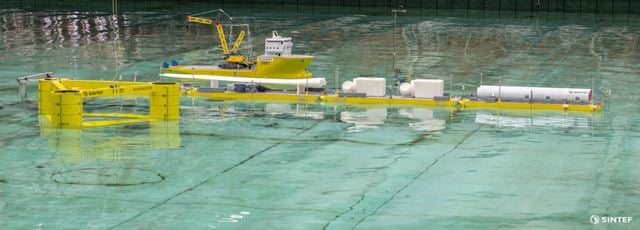
The researchers can test how several modules affect each other under different weather and current conditions. Photo: SINTEF
“Even though a structure is floating and perhaps temporary, it has to be safe and able to withstand the forces where it’s located. You need to have control over how the waves, currents and wind will impact the structure, and you have to anchor well. The modules will move slightly in relation to each other,” the researcher says.
Facts about the Ocean Basin:
The Ocean Basin is a cutting-edge facility for hydrodynamic model testing of ships, marine structures and components.
The Basin is 80 meters long and 50 metres wide. The water depth can be adjusted from 0 to 8.7 metres.
Wave machines can generate both normal and more extreme waves.
The current speed in the Basin can be adjusted, and the wind can blow against the test set-up from different angles.
Two completely new and even more advanced basins are now being built at the world-class Norwegian Ocean Technology Centre.
Complex experiments
Researchers at SINTEF Ocean use models and run tests in Trondheim’s Ocean Basin. It is an advanced test basin that is built to provide the same conditions as encountered in the open ocean.
“We use six offshore barges that we assemble in different ways. They show us that the concept is feasible, but the important thing is to have control over what happens to the modules when they’re connected,” he says.
“The port might remain in place for a long time, or it could just be there temporarily. In terms of emergency preparedness, we could have a floating port that would be in place quickly when something happens.
Analysing a single module that floats on its own is not that difficult. It only becomes complicated when you have multiple modules that are connected and need to work together while floating separately.
“You get wave splashing and hydrodynamic effects that influence each other. We can see that these hydrodynamic effects – how the water affects the movements – are complex.
The day the E6 highway disappeared
Last fall, a landslide in Levanger municipality, Trøndelag county, severed Norway’s E6 highway and the Nordlandsbanen railway, causing long-term closure of both major travel corridors.
“In a situation like this, we could imagine establishing a floating port to transport freight and people past the landslide site. I don’t know this case very well, but we could imagine building a temporary, floating port when an area is blocked off,” he says.
This solution could be put into place not only when nature creates problems, but also in times of crisis or war.
“The methods exist. We need to formalize them.
“Do we have the ports we need?” he asks. “Are they robust enough? If not, could access to a floating port be part of the solution?”
He believes that building a floating port that works well will be fully possible before too long. What is missing are the necessary regulations.
“The methods exist. We need to formalize them,” says the SINTEF researcher.
Preparedness is important – and good for the environment
He believes that floating ports are a clear advantage for both the environment and the economy. Instead of blasting mountains and seizing shoreline, you could float in a module by sea. You could build capacity without having to start major construction work.
“The port might remain in place for a long time, or it could just be there temporarily. In terms of emergency preparedness, we could have a floating port that could be in place quickly when something happens – like when the E6 is swept away,” Alsos says.
Permanent floating ports might be a solution in cities where space is limited.
“It will be a political process, but I imagine that it could be the solution to a problem,” says Alsos.
Facts about SFI Blues:
SFI Blues is a Norwegian research and innovation centre that will help the industry to develop new types of floating stationary structures for ocean-based use.
The centre works with offshore wind and solar power plants, as well as aquaculture, ports, bridges and floating terminals.
SINTEF Ocean is leading the work. NTNU, the Norwegian Geotechnical Institute NGI and the Meteorological Institute are research partners, while the users involved are Equinor, the Norwegian Public Roads Administration, Dr. Techn. Olav Olsen, Aker Solutions, Hydro, and Ocea Shipbuilding.