The surveys present responses from 1962 company employees engaged in fish farming, shipping, service vessel operation and supplier services, and 349 employees in salmon slaughterhouses and processing plants in Norway.
“The survey results indicate that aquaculture is an industry where employees enjoy their work, but at the same time experience many working environment challenges,” says Trine Thorvaldsen, a senior research scientist at SINTEF.
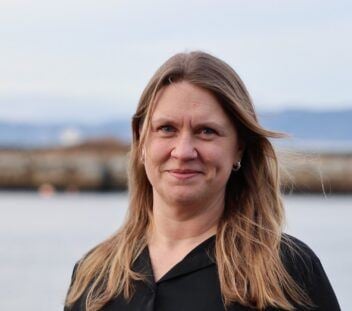
Trine Thorvaldsen is studying safety in aquaculture. Photo: Kari Williamson
The aim of the surveys, which were conducted by SINTEF Ocean and NTNU, is to provide the industry with knowledge that can be actively used in preventive HSE work.
Employees enjoy their work, despite concerns
The survey of employees in fish farming, shipping, service vessel operation and other supplier companies is a follow-up from 2023. The results show that fully 86 percent of the respondents stated that they always or most of the time find fulfilment at work. Almost two-thirds state that they also envision that they will still be working in the industry five years from now.
Still, many employees have concerns:
- About two out of three employees in this part of the industry worry that the working environment could negatively affect their health.
- Almost half worry about being exposed to an accident at work.
- Sixty-six percent of all respondents have experienced close calls in the last two years.
- Among those who work on service vessels, the percentage of respondents who have experienced close calls in the last two years is 85 percent.
Most employees believe that the company they work for takes safety seriously and that they prioritize safety in their work. At the same time, the results point to several challenges:
- Inadequate maintenance has led to poorer safety (35 percent).
- Production takes precedence over safety considerations (29 percent).
- Sometimes there is pressure to work in a way that could threaten safety (27 percent).
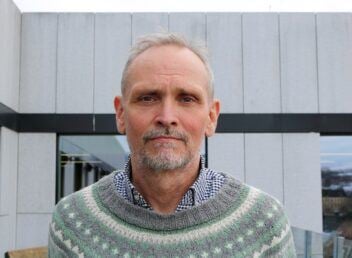
Claus Jervell, Trade union secretary in Fellesforbundet (Norway’s United Federation of Trade Unions), hopes for better safety in the industry. Photo: Fellesforbundet
“Unfortunately, we don’t see any significant improvements from the previous survey,” says Claus Jervell at Fellesforbundet (Norway’s United Federation of Trade Unions).
He is nevertheless pleased that the surveys are being conducted systematically.
“Regular surveys help increase the spotlight on HSE, and we can follow developments over time. The results highlight challenges that concern our members.”
Challenges in salmon slaughterhouse and processing facilities
For the first time, SINTEF and NTNU have also conducted an HSE survey adapted to employees working in the slaughter and processing of salmon.
“The results show that employees who slaughter and process salmon experience several stressors that can affect their health, well-being and safety over time. For example, more than half of the employees point to language differences as a challenge,” says Trond Kongsvik, a professor at NTNU.
The survey reveals several HSE challenges:
- Concern that the working environment can negatively affect health (71 percent).
- Dangerous situations can arise due to multiple languages (51 percent).
- Near-miss incidents experienced in the last two years (42 percent).
- Production considerations take precedence over safety considerations (42 percent).
The Norwegian Union of Food, Beverage and Allied Workers (NNN) has distributed the survey to its members.
“The survey results confirm the challenges that we’re familiar with, and show that there is potential for improvement to strengthen HSE in the slaughterhouse and fish processing sector. At the same time, we know that many members are systematically working on improvements,” says Yngve Hansen, who is the Federal Secretary of NNN.
The survey also shows that many slaughterhouses and processing employees experience limited participation. Almost four out of ten state that they are not involved in risk assessments or when purchasing new equipment, and 43 percent do not participate in designing new procedures.
Collaboration across companies increases risk
A separate study also shows that many of the most risky operations in aquaculture are carried out when collaborating with several companies. Delousing in particular is highlighted as demanding because it involves many actors, large forces, heavy equipment and simultaneous operations.
The researchers found considerable variation in how such work is planned and carried out, including in terms of procedures, interruption criteria and reporting of deviations.
“Good planning, clear roles and a shared understanding of risk are crucial for safety when several companies collaborate on complex operations. The study shows that this is an area where the industry has significant potential for improvement,” Siri Holen, a research scientist at SINTEF Ocean, points out.
The qualitative study looked at how collaboration between fish farming companies and leased support vessels affect the safety of aquaculture operations. The responses are based on interviews with 20 informants in fish farming, shipping companies, organizations and authorities, in addition to work observations.
Compound risk factors
The report points to several risk factors: pressure to carry out operations, inadequate staffing, high personnel turnover, insufficient training and experience, as well as challenges related to vessels, equipment and working hours. Several respondents relate that the consequences of stopping or postponing an operation are often experienced as being greater than the risks of continuing.
The survey that has now been published confirms what the interviews suggest, that both employees in supplier and in fish farming companies find poor cross-functional cooperation to be a safety risk.
Facts about the surveys and the project:
The 2026 HSE aquaculture survey and the 2026 HSE salmon industry survey were conducted from February to April 2026. A total of 2311 people participated, with 1962 employees from fish farming companies, shipping companies, service vessel companies and suppliers and 349 employees from slaughterhouses and processing plants.
The surveys were conducted by SINTEF Ocean and NTNU as part of the research project Kunnskap og tiltak for å redusere risiko for personell i havbruksnæringen (Personsikkerhet) [Knowledge and measures to reduce risk for personnel in the aquaculture industry (Personal safety)], funded by the Norwegian Seafood Research Fund (FHF).
A pilot study for sharing experiences in order to learn from incidents in the industry is also being carried out as part of the project. Incidents shared by the companies can be found on the website hmsihavbruk.no (in Norwegian).
Link to Norwegian project pages: FHF: 902016 – Kunnskap og tiltak for å redusere risiko for personell i havbruksnæringen (Personsikkerhet) – FHF [Knowledge and measures to reduce risk for personnel in the aquaculture industry (Personal safety)]
Link to Norwegian HSE portal: HMS i Havbruk' formidler kunnskap og tiltak som havbruksnæringen kan bruke i sitt interne HMS-arbeid. [HSE in Aquaculture disseminates knowledge and measures that the aquaculture industry can use in its internal HSE work.]
- The Norwegian reports in their entirety:
Knowledge and measures to reduce risk for personnel in the aquaculture industry (Personal safety): 902016 – Kunnskap og tiltak for å redusere risiko for personell i havbruksnæringen (Personsikkerhet) – FHF
HSE survey in aquaculture 2026 – Norwegian Research Information Repository (NVA): HMS undersøkelsen i havbruk 2026 – Nasjonalt vitenarkiv
HSE survey in the salmon industry 2026 – Norwegian Research Information Repository (NVA): HMS-undersøkelsen i lakseindustrien 2026 – Nasjonalt vitenarkiv
Safety and cooperation in aquaculture – A qualitative study of personal safety – Norwegian Research Information Repository (NVA): Sikkerhet og samarbeid i havbruk – En kvalitativ studie av personsikkerhet – Nasjonalt vitenarkiv