
|
Splines and CAD
The CAD and spline research in SINTEF started out in the 1960s first with a focus on ship building industry and non-linear splines (The Kurgla algorithm extensively used in ship design), resulting in the Autokon CAD/CAM-system (batch system) for ship design that in the 1970s was dominating in the world market. Iin 1974 research on interactiv CAD started which again triggered reserach into polynomial splines. From 1978 the work was focused on parametric B-splines curves, and from the early 1980s on B-spline surfaces. The work was extended to parametric NURBS curves and NURBS surfaces in the early 1990s following the requirements from CAD-industry. The introduction of isogeometric analysis by Prof. Tom Hughes in 2005 triggered our current activity on volumetric splines, and the work initiated in 2009 on Locally Refined splines.
Important project for the evolution of the SINTEF Spline technology
|
| ||||||||
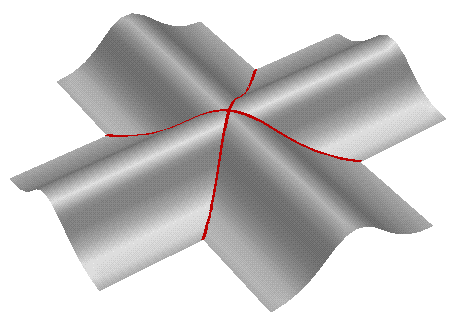
 The SINTEF polynomial spline activities has it roots in the first spline course lectured (1976) at the University of Oslo (UO) by Professor Tom Lyche . Our spline research is now a integral part of the spline research at UO's
  In 1986 Chief Scientist Tor Dokken fro SI gave a two hour tutorial on the integration of sculptured surfaces into boundary structure volume modellers at MICAD in Paris. Following this tutorial Hewlett Packard’s Workstation division contacted SI in 1987 to a establish cooperation on sculptured surface technology. A contract was signed in 1988 for the SISL library palnned to be integrated into HP’s ME30 volumetric modeller. However, HP’s planned changed, so when SISL was delivered, the volume modeller was not ME30, but ACIS. The SISL library replaced the standard spline implementation in ACIS, due to it comprehensive technology for surface intersections. This was the starting point of a long lasting cooperation, first with Hewlett Packard, then with CoCreate as HPs CAD-activity was spun out as a separate company. In 2007 CoCreate was acquired by PTC, and still the cooperation continues.
 At the start of the 1980s a number of CAD-related companies existed in Norway (Nebbcon, SRS, Kongsberg). Around 1986 a new company was established taking over the CAD-products of these companies. However, the economy hit a low cycle and the company went broke. The CM300 product that originated from Kongsberg was acquired by Norsk Data to supplement their German CAD-activity cantered around Technovision. Technovision was based on the COMPAC modeller developed by IPK in Berlin. In the APS-project (see another box) the COMPAC modeller was combined with the SI spline technology (SI merged with SINTEF in 1993). SI had already established cooperation with Norsk Data in Germany in 1984 through the APS-project, and the cooperation was strengthened to include challenges around CMD300 now renamed to Techsurf. The SI spline personnel cooperated in the coming years closely with the development team for Techsurf and Technovision in the following year. Norsk Data’s main business was mini-computers, and when the marked changed from mini-computers to PCs Norsk Data was closed, and the CAD-activity at Norsk Data terminated
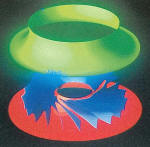 Our work on Sculptured Srufaces continued in the Germany Norwegian APS-project in close cooperation with Fraunhofer IPK in Berlin. The ambition being to develop a volum modeller combining elemenatry and B-spline surface. A close cooption was established with Norsk Data (ND) and the CAD-group acquired from the company Dietz. At the end of APS this rototype was up and running and the path to industrialiation through ND.
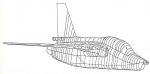 SI had started to build an activity related to industrial uses of polynomial splines by the Cand. Real thesis of Stig Ulfsby from the end of 1977, and by a establishing the Inter Nordic GPM-project. SI’s role in the project was Sculptured Surface modelling, a topic well suited for B-spline technology. GPM also had industrial partners. The main industrial discussion partner for SI was the military aircraft division of Saab in Linköping in Sweden. These discussions resulted in a conceptual requirement specification that set the direction of spline related research and development in SINTEF (SI) for almost two decades. Another aspect of the GPM-project was the development of software libraries for geometry modelling and processing. These specifications were very ambitious, so at the end of 1981 the comprehensive GPM B-spline library focused on modelling and processing of B –spline curves was developed, including intersection algorithms based on recursive subdivision combining the Lane Riesenfeld and the Oslo Algorithm